Seromucinous Borderline Ovarian Tumor: The Time, I Maybe (Possibly) Had a Little Bit of Cancer — It Depends Who You Ask
September 16, 2025
In 2008, in high school, I was diagnosed with a complex ovarian cyst. I was told it would resolve on its own. I learned years later that complex cysts are different from functional cysts and that that probably wasn’t true.
Sometime in 2017, I went to the gynecologist, or the ER, or urgent care. I had pelvic pain. Honestly, it wasn’t until 2025 that I was reminded that it even happened.
Maybe the 2008 high school cyst was the 2017 cyst, and was the 2025 cyst.
They were all on the same ovary. They all left me in agony on the bathroom floor. They all kept me home for at least the first 3 days of my period. They all made me question if I was just dramatic or if I had a low tolerance for pain.
I started to question early on, “Why is my period so bad?” “Why can’t I push through and just go to work, or school, or hang out with my friends?”
I learned the word endometriosis. I read the symptoms list online over and over again. I asked myself, “Is it really that bad?”
Then I asked my doctors. No, it can’t be endometriosis, they told me. “You get cysts. Some women are prone to more painful cysts.” I had an answer of sorts, but I had absolutely no relief.
Sign up to receive vital updates through email, and learn how you can get involved. "*" indicates required fieldsStay informed
“The Doctors Had Their Theories, But They Had Few Answers”
In 2018, I got pregnant. I have a congenital heart defect called Tetralogy of Fallot with Pulmonary Artesia.
For me, even thinking about getting pregnant required almost two years of planning. I had appointments with maternal fetal medicine, genetic counseling, my case was brought to a board of cardiologists, and then I had my 5th heart surgery.
Two days after I was cleared by my cardiologist, I got pregnant on the first try. Maybe I was wrong. It couldn’t have been endometriosis. After all, everything I read said that endometriosis causes infertility.
Pregnancy was beautiful and exciting, but it was uncomfortable, difficult, and exhausting.
In 2019, I gave birth to the most amazing little girl in the world. Two days later, I was sent home with tunnel vision, neck pain, and the worst headache I have ever had.
By this point in my life, I was conditioned to keep my pain to myself. After being told by several doctors over the years to “take motrin,” I expected the same response again. I had never had a baby before. I had trouble dealing with “normal” period pain; of course I was having trouble with the discomfort of giving birth.
I got home and fell asleep. I did not hold my baby. My husband did. I did not wake up when she cried. My husband did. He helped her latch onto my breast as he gently woke me from my deep, dark, and painful sleep.
I do not remember the first week of my child’s life. I nourished her, she laid on my chest, but I do not remember looking into her eyes. I do not remember who came to meet her. After a week, I decided, “maybe I am not being dramatic”. I was admitted back into the hospital with a high fever and a concerning white blood cell count.
Meningitis, endometritis (a pelvic infection, not to be confused with endometriosis), or internal bleeding: the doctors had their theories, but they had few answers.
After four days of IVs, a failed attempt at a spinal tap, continuous heart monitoring, MRI, EKG, and ultrasound the results were inconclusive. “Suspected endometritis” was written in my chart and I was sent home. The fever was gone and the blood tests were on their way back to normal.
“For the First Time, Somebody Listened to My Story”
I breastfed my baby for 2 years, and again despite everything I was told, my experience was different.
From what I understood, exclusively breastfeeding should have delayed my period. Mine came back just four weeks after I gave birth. The pain was worse than anything I had ever experienced. I would have done anything for the pain I felt back in high school. What I felt when I hid on the floor of my favorite teacher’s empty classroom was nothing compared to this.
When my daughter turned five years old, I begged the universe not to let me have my period on our trip to Disney World.
By January 2025, the pain I was so accustomed to quickly transitioned to a very real concern. There were days that I could not walk without crying. I fainted in the shower. The tunnel vision returned one day when I was reading stories to my daughter and her friends. I had heart palpitations and cold sweats.
I then caved and finally called the gynecologist. My appointment was with one of the highly recommended nurse practitioners.
 For the first time since, well, ever, a provider actually listened to my story. She told me that she wanted to run several tests, she wanted blood work. She told me that I should not be in this much pain. She told me that I deserved to feel better.
My bloodwork was fine; nothing noteworthy to report. The ultrasound, on the other hand, revealed a medium sized complex ovarian cyst, results consistent with an endometrioma, also known as “chocolate cyst.”
I planned on waiting until my scheduled follow-up appointment to find out what would happen next, but the pain quickly got worse. Somehow, I convinced myself that I only felt it was worse because now I knew that something was there. I was just scared, I told myself. Again, I was just being dramatic.
Either way, I made a sooner appointment. The night before that appointment, I was woken up by what felt like active labor pains. I threw up a few times and I was covered in sweat. If I didn’t have an appointment in the morning, I would have gone to the emergency room. I thought I was going to die. The next morning I cried in a doctor’s office for the second time in my adult life. The first time was when I told my cardiologist that I wanted to have a baby. This time, I sobbed, I bawled, I hyperventilated. I just didn’t want to be in pain anymore.
I was sent for an MRI and another ultrasound. The cyst was actually shrinking. Then I read the report. I read the full diagnostic report. Under impressions it read, “Of note, a right ovarian cyst has been present since baseline ultrasound of 4/28/2017.” I was reading this report in March 2025.
A few weeks later, I had a surgical consult. I was instructed by the medical assistant to undress from the waist down. She wasn’t sure if the doctor needed to do an internal exam. He walked in and confirmed that no further exams were needed. I promptly said, “I am going to put my pants back on for this conversation”.
After I changed, he returned, quickly shook my hand and reported that he was “not that impressed” by the size of the cyst. He reiterated what the MRI results confirmed: the cyst was shrinking. I reminded him that it had shrunk to its baseline size from almost eight years ago. I insisted that the cyst be removed.
In May 2025, I underwent a laparoscopic removal of the cyst. Six days post-surgery, I was laying on the couch wondering why I wasn’t feeling better yet. The doctor had clearly said, I should feel better within three days. I was asking myself why I was once again having such a low tolerance for pain.
Then the phone rang. When I heard the doctor’s voice I assumed he was just calling to check on me. Then he said it.
“We send all cysts for biopsy. Typically ovarian tumors are either benign or they are malignant. Yours was borderline.”
The response fell out of my mouth, “So it wasn’t endometriosis?”
He wasn’t sure, but he informed me that he was sending my cyst to the lab for more testing. He told me I would receive a call from an oncologist’s office to schedule an appointment. I did not register the word “oncologist” until after I hung up. Benign, malignant. I knew these words, but my brain refused to process their meaning until I had a quiet moment to myself.
A week later, the pathology confirmed, Borderline seromucinous tumor, stemming from an endometrioma. I had endometriosis, adenomyosis, and borderline ovarian cancer.
“So, It’s Cancer?”
A few weeks later I met my oncologist. I asked my husband about 20 times after she walked out of the room. “So, it’s cancer?”
She explained that while borderline ovarian cancer is non-invasive and very slow growing, it is “a type of cancer.” The diagnosis is controversial and the treatment, even more so. Some doctors call it cancer, some do not. This is something I am still not able to process. Do I deserve this label? Was I sick enough to say, “I had cancer?”
I received three diagnoses at the same time: endometriosis, adenomyosis, and maybe-it-could-possibly-it-depends-who-you-ask cancer.
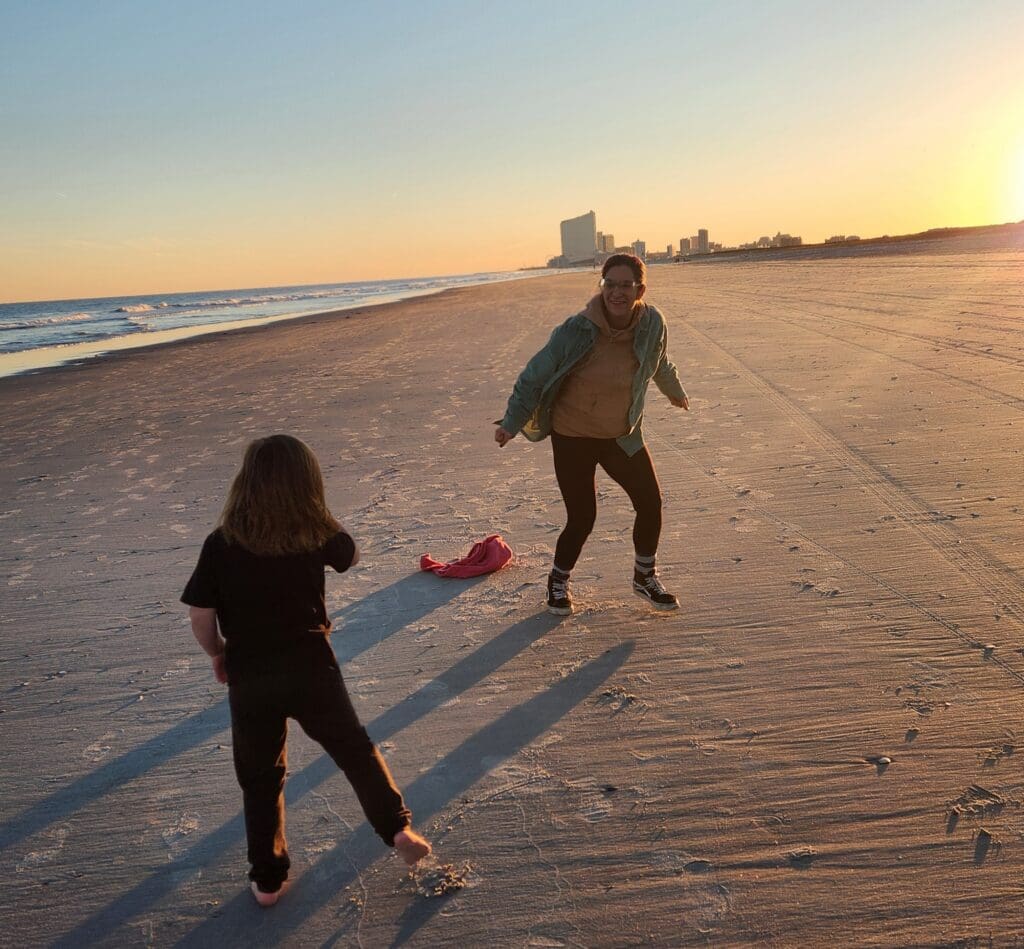 Cancer or not cancer, I still required specialized care and yet another surgery. In June 2025, one month and two days after the first surgery, a few days after my 34th birthday, I had a full hysterectomy. Where my reproductive system used to be, I now have one lonesome little ovary, left there only to avoid surgical menopause.
A week after surgery, it was officially confirmed. I have stage III endometriosis. (Several lesions were removed by the oncologist during the second surgery.) More importantly, there was no evidence of remaining borderline tumor or cancer cells.
I hung up after listening to what should have been the happiest voicemail I would ever receive. The problem was, I did not feel relieved, I was not happy. I was furious. I was sad. I was heartbroken. I called and texted everyone who knew what I was going through. They all celebrated while I mourned.
I was so mad at myself for feeling this way. I was being ungrateful. I was being… dramatic.
I was lucky. But the truth is, several competing facts were true at the same time. I was incredibly lucky. I had been incredibly sick. I still have endometriosis. It was all too much to process.
On July 10, 2025, I had my first of many CA125 (cancer antigen) bloodwork appointments. Every three months for the foreseeable future, my blood would be tested and ultrasounds would be completed to see if the cancer cells had returned.
I held back tears as I walked back to the car. I slowly sunk into the driver’s seat and closed the door. As soon as the sounds from outside were dulled, I let myself feel everything I had been holding in. I cried hard for 35 seconds. Then I went to get a macchiato and a bagel. I sat outside that cafe for 2 hours. I was probably going to be okay, but okay was not going to be easy.