
NCCN Guidelines for Ovarian Cancer: What They Mean for Your Treatment and Insurance Coverage
February 10, 2026

When you’re facing an ovarian cancer diagnosis, understanding NCCN guidelines for ovarian cancer can be the difference between your insurance approving treatment immediately or denying it altogether.
The National Comprehensive Cancer Network (NCCN) guidelines aren’t just medical recommendations; they’re the gold standard that insurers use to decide whether they’ll cover some of your medical expenses.
And here’s something most patients don’t realize: these guidelines can cover treatments beyond what the FDA has officially approved, potentially opening doors to therapies you might not have known were accessible.
Sign up to receive vital updates through email, and learn how you can get involved. "*" indicates required fieldsStay informed
What Are NCCN Guidelines and Why Do They Matter?
The NCCN is an alliance of leading cancer centers across the United States.
Their clinical practice guidelines represent what multidisciplinary panels of cancer experts — oncologists, surgeons, researchers, and patient advocates — agree constitutes the best approach to treating specific cancers.
Notably, the NCCN provides management recommendations for 97% of patients with cancer, and an estimated 95% of oncologists rely on these guidelines in their practice. It’s worth keeping in mind that these are expert recommendations, not mandates. But their near-universal adoption among cancer specialists is a strong signal of how trusted and authoritative they are in the field.
For ovarian cancer specifically, these guidelines outline stage-specific standards of care, from initial diagnosis through treatment and follow-up. They’re updated continuously as new research emerges.
Here’s why this matters to you financially: The Centers for Medicare and Medicaid Services (CMS), UnitedHealthcare, and virtually every major insurance company in the United States recognizes NCCN guidelines as authoritative references when making coverage decisions.
When your doctor recommends a treatment listed in the NCCN ovarian cancer guidelines, your insurer is far more likely to approve it without lengthy appeals.
According to research, more than half of ovarian cancer patients don’t receive care that follows NCCN guidelines. The primary driver? Where a patient gets treated.
The research found that low facility case volume was the strongest independent predictor of non-guideline care, and 65% of U.S. cancer centers treat fewer than 8 ovarian cancer cases per year. Put simply, most hospitals see so few ovarian cancer patients that they lack the subspecialty expertise and multidisciplinary infrastructure required to consistently deliver guideline-adherent care. Other factors, including older patient age and higher rates of comorbidities, also played a role.
This gap matters, because receiving guideline-adherent care was independently associated with better survival outcomes.
How NCCN Guidelines Are Developed
 The NCCN doesn’t create guidelines in a vacuum. Each guideline goes through a rigorous, transparent development process.
Multidisciplinary expert panels continuously review clinical trial data, published research, and emerging evidence. According to the NCCN Guidelines for Patients development documentation, these panels consist of medical oncologists, surgical oncologists, and patient advocates, ensuring multiple perspectives inform each recommendation.
The process includes evaluation of peer-reviewed literature, integration of expert clinical judgment, and regular updates as new data becomes available.
In practice, there’s an annual review cycle, but the NCCN can also convene between meetings when significant new research or FDA approvals warrant immediate attention.
From the moment promising clinical trial data first appears, it typically takes around 15 months for a treatment to make it into the guidelines, though that timeline can vary. The NCCN also manages potential conflicts of interest through rigorous disclosure requirements.
The NCCN Compendium: Your Key to Treatment Access
Here’s where things get really important for insurance coverage: the NCCN Drugs and Biologics Compendium (often called the NCCN Compendium).
The NCCN Compendium is a continuously updated database that lists both FDA-approved uses of cancer drugs AND appropriate uses beyond the FDA-approved label. This second category — called “off-label” use — is crucial because cancer doesn’t always fit neatly into FDA approval categories.
This matters especially for rare ovarian cancer subtypes like low-grade serous ovarian cancer and borderline ovarian tumors. Because these cancers affect smaller patient populations, pharmaceutical companies have limited financial incentive to pursue formal FDA approval specifically for these subtypes. But when effective treatments are added to the NCCN Compendium after successful clinical trials, doctors can prescribe them and insurance will cover them, even without disease-specific FDA approval. This pathway can get life-saving treatments to patients years faster than waiting for traditional approval.
What Makes the Compendium Different
The Compendium extracts recommendations directly from NCCN Guidelines and categorizes them based on the type and quality of evidence supporting the recommendation, the degree of consensus among panel experts, and clinical context.
All recommendations in the NCCN Compendium, regardless of their evidence category, constitute appropriate, medically necessary care. This designation is powerful when dealing with insurance companies.
NCCN Listings and Insurance Coverage
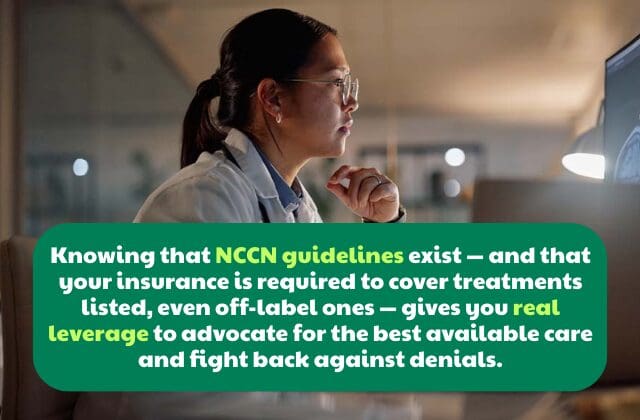
Federal law requires that Medicare Part B cover off-label cancer drug uses if they’re included in recognized compendia, with the NCCN Compendium being the most widely referenced. Most private insurers follow similar policies.
This means if your gynecologic oncologist recommends a treatment for your low-grade serous ovarian cancer that’s listed in the NCCN Compendium — even if it’s not the drug’s FDA-approved indication — your insurance should cover it.
What NCCN Guidelines Mean for You and Your Family
Beyond insurance coverage, NCCN guidelines serve as your roadmap for navigating treatment decisions and ensuring you’re receiving evidence-based care. Understanding how to use them puts you in a stronger position to advocate for yourself and make informed choices alongside your medical team.
Getting the Right Care from the Start
Understanding that NCCN guidelines exist and matter can help you advocate for yourself from your very first appointment. Research shows that high-volume cancer centers are significantly more likely to deliver guideline-adherent care, which matters because guideline care is directly linked to better outcomes.
If possible, seek treatment from a gynecologic oncologist at a center with substantial ovarian cancer experience.
When discussing ovarian cancer treatment options, you can ask your doctor:
- Is this treatment in line with NCCN guidelines?
- What NCCN category of evidence supports this recommendation?
- If this isn’t standard NCCN care, why are we considering it for my specific situation?
Financial Implications: When Guidelines Meet Reality
Understanding NCCN guidelines is one thing. Getting insurance to pay for recommended treatments is another. Even with strong guideline support, you’ll likely encounter administrative hurdles and out-of-pocket costs that require careful navigation.
Prior Authorization and Appeals
Even with NCCN support, you may face prior authorization requirements: your insurer’s way of reviewing treatments before approving them. Your doctor’s office will need to submit documentation showing that the recommended treatment aligns with NCCN guidelines.
If your initial request is denied, don’t panic. Many denials are overturned on appeal, especially when armed with NCCN guideline references. Your ovarian cancer treatment team should be experienced in this process.
Out-of-Pocket Costs
Even when insurance covers NCCN-recommended treatments, you’ll likely face copays, coinsurance, and deductibles. Understanding what’s covered helps you plan financially. Resources include patient assistance programs from pharmaceutical manufacturers, non-profit financial assistance organizations, and hospital financial counselors.
For more information on managing expenses, explore our guide on ovarian cancer treatment cost and ways to make cancer care more affordable.
Clinical Trials and Guidelines
NCCN guidelines also address when clinical trial participation is appropriate. For certain situations, particularly with rare subtypes like LGSOC and BOT, clinical trials may represent your best option.
The Bottom Line: Guidelines as Your Advocacy Tool
NCCN guidelines for ovarian cancer serve a dual purpose: they guide doctors toward evidence-based care while simultaneously providing the framework insurers use to make coverage decisions.
For you as a patient, these guidelines represent a roadmap of standard care, leverage in insurance negotiations, a benchmark for evaluating your treatment plan, and access to both FDA-approved and carefully vetted off-label treatments.
At Not These Ovaries, we believe that action and understanding will save lives. Part of that understanding includes knowing the systems that determine not just what treatment you receive, but whether you can access it at all.
When you’re navigating an ovarian cancer diagnosis, knowledge truly is power. Understanding how NCCN ovarian cancer guidelines work gives you one more tool in your arsenal as you face this disease.