
Let’s Talk About Ovarian Cancer and Mental Health
May 5, 2026

Ovarian cancer and mental health are far more deeply connected than most treatment plans acknowledge. This gap in care has real consequences.
When someone receives an ovarian cancer diagnosis, the immediate focus naturally turns to surgery schedules, chemotherapy protocols, and oncology appointments. But underneath all of that, something else is happening. Fear is setting in. Identity is shifting. And for many women, a quiet psychological crisis is unfolding that no one on their care team has thought to ask about.
That needs to change.
The Emotional Weight Starts Before Treatment Even Begins
The mental health toll of ovarian cancer begins long before the first treatment.
Many women spend months, sometimes years, being dismissed by doctors before receiving a diagnosis. Symptoms like bloating, pelvic pain, and changes in appetite are routinely attributed to IBS, stress, or “nothing serious.”
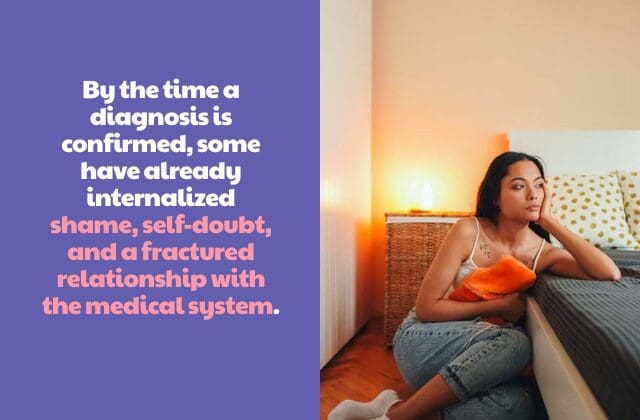
By the time a diagnosis is confirmed, some women have already internalized shame, self-doubt, and a fractured relationship with the medical system. Many women develop a form of medical PTSD: years of being told they’re fine when their body is telling them otherwise.
That experience leaves a mark. And it means that on the day of diagnosis, many patients aren’t starting from neutral; often, they’re starting from exhausted.
The diagnosis itself then brings a whole new set of emotional responses. Shock. Grief. A strange relief that someone finally believed them. Fear of what comes next. These aren’t signs of weakness. They’re signs of being human in an overwhelming situation.
How Diagnosis and Treatment Affect Mental Health
Research consistently shows that women with ovarian cancer experience depression and anxiety at significantly higher rates than the general population.
One study tracked over 1,600 ovarian cancer survivors and found that in the first two years after diagnosis, women were more than 3.5 times more likely to be diagnosed with an anxiety disorder and nearly 3 times more likely to be diagnosed with depression, compared to women without cancer. Even two to five years after diagnosis, those risks remained meaningfully elevated.
Another study found that depression was present in roughly 25% of ovarian cancer patients before treatment began. Moreover, anxiety actually increased as treatment progressed, remaining elevated even after treatment ended.
But beyond the statistics, what does this actually feel like?
Women describe a relentless mental undertow. The anxiety doesn’t peak and then resolve; it shifts shape. Early on, it’s about the diagnosis. During treatment, it becomes about side effects, scans, and whether the chemo is working. After treatment ends, it morphs into something called scanxiety: the dread that builds before every follow-up scan, the fear that cancer has returned.
Then there’s the identity piece. Ovarian cancer treatment often brings sudden surgical menopause, infertility, changes to sexual function, and significant physical transformation.
For many women, the loss of fertility cuts especially deep. The ability to create life is, for so many, foundational to their sense of womanhood. When that’s taken away, it’s not just a medical side effect. It’s a grief that touches identity at its core. These losses are real, they are layered, and when left unaddressed, they can quietly feed depression in ways that don’t always look like depression from the outside.
Mental Health Burden for LGSOC and BOT Patients
 For women diagnosed with low-grade serous ovarian cancer (LGSOC) or borderline ovarian tumors (BOT), the mental health burden carries an additional, lonelier dimension.
These patients often don’t require chemotherapy. They don’t lose their hair. And yet they live in a constant cycle of surveillance scans, potential recurrences, and profound uncertainty. Well-meaning people tell them they “look great,” not realizing that visible signs of treatment aren’t the measure of what someone is going through.
The result is a kind of isolation that’s hard to name. Many BOT and LGSOC patients describe feeling like they don’t fully belong in traditional cancer support spaces: too sick to feel “normal,” but not sick enough to feel seen.
And unlike most cancers, where reaching five years of NED brings some version of “you’re cured,” LGSOC and BOT don’t work that way. They are chronic, lifelong diagnoses. Recurrence can happen at any point, which means there is no finish line to cross, no moment where you finally get to feel like it’s behind you.
That particular weight — the not-knowing, the never quite being on the other side of it — is its own form of psychological burden, and one that rarely gets acknowledged. That in-between place can be deeply painful, and it’s one reason why finding a community that genuinely understands your specific diagnosis matters so much.
Why Mental Health Often Goes Untreated in Ovarian Cancer Patients
 One of the more sobering findings in the research: a significant number of ovarian cancer patients who are experiencing depression or anxiety never receive mental health support.
Part of this is systemic. Oncology appointments are focused on physical treatment. Mental health screening isn’t always built into the care plan. And in community settings, where the majority of cancer care actually happens, mental health resources may be limited or hard to access.
Part of it is also the patients themselves. Many women push their emotional struggles aside because they don’t want to be perceived as not coping. There’s a pressure — sometimes self-imposed, sometimes from family — to stay strong, stay positive, keep going.
But here’s what the evidence tells us: women who don’t receive mental health support during their ovarian cancer journey tend to have significantly worse outcomes overall. Which means getting real help for anxiety and depression isn’t a side issue. It belongs right at the center of your care plan.
What You Can Actually Do: Practical Steps for Protecting Your Mental Health
Knowing all of this can feel heavy. But there are real, concrete things patients can do.
Tell your care team how you’re actually feeling.
This sounds simple, but many patients don’t do it. If your oncologist asks “how are you?” and you say “fine” when you’re not fine, nothing changes. Be honest. Sleep disruption is a good starting point; it’s often easier to raise than “I’ve been feeling hopeless.” Mention it. It can open a door.
If you’re in a community setting without an in-house social worker or psychologist, ask your oncologist to refer you to someone external. You deserve that.
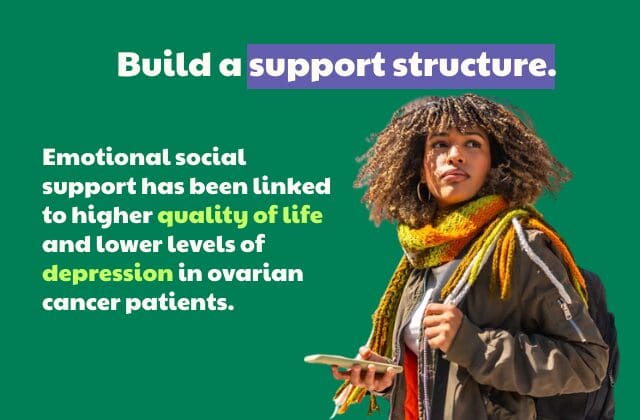
Build a support structure.
Emotional social support has been linked to higher quality of life and lower levels of depression in ovarian cancer patients. But “support” doesn’t just mean whoever happens to be around. Think about who actually helps you feel seen versus who adds anxiety to your day. You’re allowed to be selective.
Some people find peer support communities (online or in person) genuinely life-changing. Hearing from someone who has been exactly where you are carries a weight that clinical reassurance simply can’t. Consider exploring ovarian cancer support groups designed specifically for this community.
Create a simple self-care framework (before you need it).
Don’t wait for a crisis to figure out what helps you cope. Think about five dimensions of well-being: physical (sleep, hydration, gentle movement), emotional (journaling, therapy, mindfulness), cognitive (hobbies, curiosity, creativity), social (connection with others), and spiritual (whatever grounds you — nature, faith, stillness).
Pick one thing from each category. Write it down. Know what you’re reaching for when things get hard.
Be careful with online research.
Looking up statistics on ovarian cancer outcomes can quickly become destabilizing. Survival statistics are averages. They don’t account for your specific diagnosis, your treatment, or the advances in research happening right now. Stick to reputable sources. If a forum is making you feel worse, leave it.
Consider professional mental health support, not just peer support.
Cognitive behavioral therapy (CBT) has evidence behind it for managing cancer-related anxiety and depression. Some patients also benefit from medication, particularly if sleep disruption and mood symptoms are severe. If you’re open to it, ask your care team about a referral to a psychologist or psychiatrist who has experience with oncology patients.
And if you’re in a dark place, reach out. You don’t have to be in an immediate crisis to deserve help.
The Connection Between Mental Health and Physical Outcomes
This is the part that tends to get the medical community’s attention: mental health doesn’t just affect how patients feel; it also affects how they do.
Clinically, depression and anxiety in cancer patients have been associated with lower treatment adherence, more hospitalizations, and poorer outcomes. Taking care of your mental health is not a luxury or an indulgence. It’s part of fighting this disease.
Ovarian cancer changes everything. Your body, your relationships, your sense of the future. And the mental and emotional weight of that is real, whether you’ve just been diagnosed, are mid-treatment, or are living in survivorship.