
Platinum Resistant Ovarian Cancer vs. Platinum Sensitive: What the Difference Means
September 30, 2026

If your doctor has used the phrase “platinum resistant ovarian cancer”, you probably heard the word “resistant” and stopped listening for a second. That reaction makes sense. It sounds like a door closing.
It isn’t. What those words describe is timing. Specifically, they describe how long your cancer stayed away after your last dose of platinum chemotherapy, and that timing is what your care team uses to choose what comes next.
Here’s what the labels mean, why they shape your treatment plan, and what has genuinely changed in the last three years.
The Definition of Platinum Resistant Ovarian cancer, in Plain Language
 Platinum chemotherapy means carboplatin or cisplatin. Nearly every woman treated for epithelial ovarian cancer gets one of them, usually paired with a taxane like paclitaxel.
Your doctors count the months between your last platinum dose and the day your cancer comes back. That gap has a name: the platinum-free interval. It is the only thing these labels are based on.
Six months or more before the cancer returns, and it’s called platinum sensitive. Less than six months, and it’s called platinum resistant.
The Categories Your Oncologist May Use
In the US, oncologists generally follow guidance from the National Comprehensive Cancer Network (NCCN) and the American Society of Clinical Oncology (ASCO). Day to day, that means the six-month line is the one that counts:
- Platinum sensitive: the cancer comes back six months or more after your last platinum dose
- Platinum resistant: the cancer comes back less than six months after your last platinum dose
You may also hear the term platinum refractory. It describes cancer that keeps growing during platinum treatment or very shortly after it ends. Treatment options for refractory disease generally overlap with those for platinum-resistant disease.
In research papers, you might also come across a “partially platinum sensitive” group for recurrence between six and twelve months. It isn’t how treatment decisions are usually framed in US clinics, so don’t be thrown if your oncologist never uses it.
If you land near the line, say at five and a half months, you are not automatically in the harder category. Your oncologist weighs how well you responded the first time, how you tolerated treatment, and what your scans show. Sensitivity behaves more like a dial than a switch.
Platinum Sensitive vs Platinum Resistant Ovarian Cancer
The label matters because it predicts whether platinum will work again.
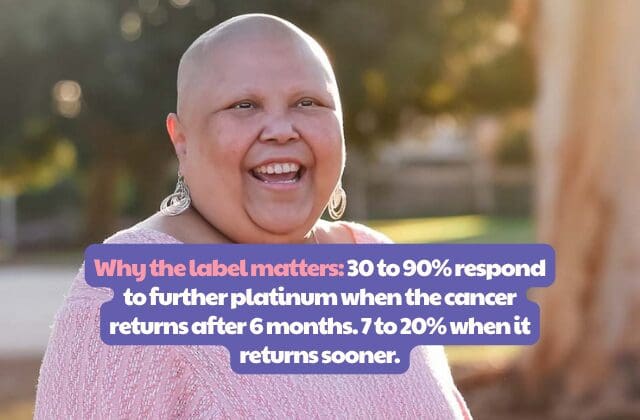
According to one study, women whose cancer returns after six months respond to further treatment somewhere in the range of 30% to 90% of the time, and the longer the gap, the better the odds. Women whose cancer returns inside six months respond far less often, roughly 10% to 15%.
One thing worth understanding early: ovarian cancer recurrence is common in advanced disease, and each recurrence tends to arrive sooner than the last. Many women are platinum sensitive at first recurrence and platinum resistant by the third. That progression is expected. It is not something you did wrong.
Sign up to receive vital updates through email, and learn how you can get involved. "*" indicates required fieldsStay informed
Resistance that Shows up Late vs. Resistance that was There from the Start
There are two different stories here, and they get lumped together too often.
Acquired resistance develops over time. Platinum worked, then worked less well, then stopped working. This is the more common path.
Primary resistance means the cancer never responded much to begin with. It shows up during first-line treatment or immediately after. Studies put this at roughly one in five to one in six women with epithelial ovarian cancer.
The distinction matters more than it sounds. The women in the study with primary resistance were more likely to have advanced-stage disease, ascites, a poorer performance status at diagnosis, and no debulking surgery. And critically, the trials that produced today’s best options often excluded them. Primary resistance remains one of the least-studied situations in the entire disease.
There’s a subtype angle here too. Low-grade serous, mucinous, and clear cell ovarian cancers frequently show limited platinum response from the outset. Because they’re rarely enrolled in platinum trials, the research base is thin. If you have one of these diagnoses, our articles on chemotherapy for LGSOC and LGSOC drugs are worth reading, because the standard playbook may not be your playbook.
Platinum Sensitive Ovarian Cancer Treatment
 When your cancer is platinum sensitive, the strategy is straightforward. Use the drug that already proved itself.
That usually means platinum-based combination chemotherapy, carboplatin paired with paclitaxel, gemcitabine, or pegylated liposomal doxorubicin. Combinations outperform single agents in this setting. If you want a fuller picture of what these regimens involve, see our guide to chemotherapy drugs for ovarian cancer.
After that round finishes, your oncologist may recommend a PARP inhibitor as maintenance therapy (for high-grade serous ovarian cancer). These pills block one of the repair systems cancer cells use to fix their own DNA. But at recurrence, current NCCN and ASCO guidelines narrow who should get one.
You generally need three things: a BRCA mutation (inherited or found only in the tumor), a complete or partial response to your most recent platinum-based chemotherapy, and no history of your cancer progressing while on a PARP inhibitor.
That’s a change from a few years ago, when these drugs were offered more broadly after recurrence. As first-line maintenance after initial treatment, PARP inhibitors are still an option for some women without a BRCA mutation.
Bevacizumab, which cuts off a tumor’s blood supply, is another common addition. And for some women, a second debulking surgery before chemotherapy is on the table.
Platinum Resistant Ovarian Cancer Treatment: What the Options Look Like Now
This is where the last few years have actually changed things.
Single-agent chemotherapy without platinum remains the foundation. Weekly paclitaxel, pegylated liposomal doxorubicin, topotecan, or gemcitabine, given one at a time rather than in combination. Side effects are often more manageable than a heavy platinum doublet, which matters when treatment becomes long-term.
Bevacizumab added to that chemotherapy was the first real improvement here. In the AURELIA trial, adding it nearly doubled the time before the cancer grew again, from 3.4 months to 6.7 months, and eased abdominal symptoms.
Antibody-drug conjugates deliver chemotherapy directly to cancer cells carrying a specific marker. Mirvetuximab soravtansine targets folate receptor alpha, which about a third of tumors express at high levels. In the phase 3 MIRASOL trial, it improved median overall survival to 16.5 months compared with 12.8 months on standard chemotherapy, and shrank tumors in 42% of women versus 16%. This requires a tumor test. Ask whether yours has been done.
Relacorilant is the newest addition. Combined with nab-paclitaxel, it improved median overall survival from 11.9 months to 16.0 months in the ROSELLA trial, and the FDA approved it in March 2026. Notably, the benefit held across subgroups regardless of platinum-free interval length or prior PARP inhibitor use.
Clinical trials deserve more than a mention at the bottom of the list. Nearly every option above started as a trial, and platinum-resistant disease is exactly where the most active research sits.
Why the 6-month Rule is Starting to Blur
The six-month cutoff is still how oncologists sort recurrent ovarian cancer every day. ASCO’s guidance uses it too, but notes that platinum sensitivity falls on a spectrum and leaves room for clinical judgment.
Here’s why that flexibility matters.
The cutoff traces back to research from the early 1990s, before routine CA-125 monitoring for surveillance and modern imaging became standard. Back then, recurrence was usually found when a woman felt sick. Now it’s often caught on a blood test or scan months earlier, which shortens the measured interval without the biology having changed at all.
Maintenance therapy complicates it further. PARP inhibitors and bevacizumab push recurrence later, which stretches the platinum-free interval. Meanwhile, research suggests prior PARP inhibitor treatment can itself make later platinum less effective, and can weaken the platinum-free interval as a predictor.
These issues led the Gynecologic Cancer InterGroup to propose in 2015 that clinical trials use the treatment-free interval instead, considered alongside subtype and prior therapies. In US clinics, though, the six-month line still guides decisions. Some oncologists simply frame it as a more practical question: is platinum still a reasonable option for you?
What to Ask Your Care Team
Bring these to your next appointment:
- What exactly is my platinum-free interval, and which category does that put me in?
- Given that number, is another round of platinum still worth considering, or should we switch?
- Has my tumor been tested for folate receptor alpha, and for BRCA or other mutations?
- What clinical trials am I eligible for right now, not later?
- Has my case been reviewed by a tumor board?
- How will we measure whether this treatment is working, and when?
Our list of 20 questions to ask about recurrent ovarian cancer goes deeper, and understanding RECIST criteria will help you read your own scan reports.
If your team has offered one option and closed the conversation, an ovarian cancer second opinion is reasonable. In a field moving this quickly, no single oncologist tracks everything.
What These Words Don’t Tell You
Platinum resistance describes how one class of drug is behaving in your body at one moment in time. It is a piece of information, and a useful one, because it points your team toward what to try next.
Ask the specific questions. Get the testing done. Keep trials on the table from the beginning rather than saving them for last.