
14 Ways to Advocate for Yourself After an Ovarian Cancer Diagnosis
April 3, 2026

Self-advocacy is the ongoing process of learning what you need as a patient and actively working to make sure those needs are met — with your medical team, your support system, and in your own day-to-day life.
It means asking questions even when you feel like you’re supposed to just follow instructions. It means pushing for a second opinion when something doesn’t sit right. It means tracking your symptoms, owning your records, and showing up to appointments prepared.
For women with low-grade serous ovarian cancer (LGSOC) or borderline ovarian tumors, this is especially true. These subtypes are rarer, less researched, and frequently misunderstood — even by providers. Knowing how to advocate for yourself can directly affect the quality of care you receive.
The tips below are practical, grounded in real patient experiences, and organized by where you are in the journey.
Before Your Appointment
What you do before you ever walk into a doctor’s office can set the tone for everything that follows. A little preparation goes a long way.
1. Understand that a Pap smear won’t catch this
This is one of the most important things to know, and also one of the most common misconceptions. Pap smears screen for cervical cancer only. They do not detect ovarian cancer, uterine cancer, or other gynecologic cancers.
If you have persistent symptoms of ovarian cancer — bloating, pelvic pain, feeling full quickly, frequent urination — and your most recent Pap was normal, that’s not reassurance. That’s a gap in the picture. You need to specifically raise ovarian cancer concerns with your provider and ask for appropriate follow-up.
2. Know your personal risk factors before you walk in the door
 Before you sit across from a doctor, it helps to already have a clear sense of your own risk profile. This isn’t about diagnosing yourself. It’s about having a productive conversation.
Key risk factors for ovarian cancer include:
- Age: Risk increases significantly after 50, particularly post-menopause (It’s worth noting that for subtypes like LGSOC and borderline tumors, the average age of diagnosis is 45 years old.)
- Family history: A first-degree relative (mother, sister, daughter) who has had ovarian, colon, or breast cancer raises your risk
- Genetic mutations: BRCA1 and BRCA2 mutations are among the most significant; genetic testing for LGSOC can also uncover other relevant mutations like KRAS
- Reproductive history: Never having been pregnant, or having children later in life, may increase risk
- Endometriosis: There is a documented connection between endometriosis and ovarian cancer subtypes
If you have a family history of ovarian or breast cancer, bring that information with you (documented, if you can). Genetic history has real clinical implications.
3. Keep a symptom diary
Ovarian cancer symptoms are notoriously vague. Bloating, fatigue, pelvic pain and discomfort: these overlap with dozens of other conditions. That’s exactly why documentation is so powerful.
Start tracking your symptoms as soon as something feels off. Write down what the symptom is, how severe it is, how often it happens, how long it lasts, and what makes it better or worse.
A diary turns a feeling into evidence. When a patient pulls out a detailed diary showing that the same symptom has occurred repeatedly over several weeks, it demands a different level of attention than “I feel like this happens a lot.”
4. Write down your questions — every single one
Medical appointments move fast. You’ll have things you want to say, and then a doctor walks in and half of them disappear. Write the questions down before you go. All of them, including the ones that feel obvious or embarrassing.
A solid list of questions to ask your oncologist might include: What subtype of ovarian cancer do I have? How does that affect my treatment options? What stage am I, and what does that mean for my prognosis? Are there ovarian cancer clinical trials I should know about? What are the short- and long-term side effects of each treatment option?
For LGSOC and borderline tumor patients specifically, it’s worth asking: Is my doctor familiar with these subtypes? These cancers behave differently from high-grade disease, and not all oncologists have deep experience with them.
During Appointments
The appointment itself is where preparation pays off.
5. Bring someone with you — and give them a job
 Not just for moral support. Give the person you bring an actual role: take notes, listen for things you might miss, and help you process what was said afterward.
When you’re scared or overwhelmed, your brain does not retain information well. That’s not a weakness; it’s human physiology. Having a second set of ears means you’re less likely to leave with a distorted version of what your doctor actually told you.
If you have to attend an appointment alone, ask if you can record it on your phone. Many providers are open to this, and having the audio to replay later can be invaluable.
6. Ask for things to be explained in plain language
Medical jargon is a communication barrier. And it’s not your job to wade through it unaided. If a doctor uses a term you don’t understand, stop them and ask for a simple explanation.
You can also ask: “Can you explain what that means for my day-to-day life?”
That reframes clinical information in terms of what actually affects you. What does adjuvant chemotherapy mean for how I’ll feel next month? What does debulking surgery mean for my recovery time? These are fair questions, and any good doctor will welcome them.
7. Own your medical records — literally
You have the legal right to your own health information. Request copies of your pathology reports, imaging results, surgical notes, and lab work. Keep them organized. Bring them to every appointment.
This matters for several practical reasons. If you see a new specialist or seek a second opinion, you won’t be starting from scratch. If there’s ever a discrepancy in your records, you’ll catch it. And reading your own records, even if some of it is hard to parse, helps you stay an active participant in your care.
Some hospitals offer online patient portals where you can access results directly. Ask about this at your next visit.
Navigating Treatment
 Once you have a diagnosis and a treatment plan, a new phase of advocacy begins, one that requires you to stay engaged, ask hard questions, and push for clarifications.
8. Seek a second opinion — without guilt
A second opinion is not a betrayal of your doctor. It’s a standard part of making an informed medical decision. Reputable oncologists expect it and support it. If a provider seems bothered by the idea, that itself is information worth noting.
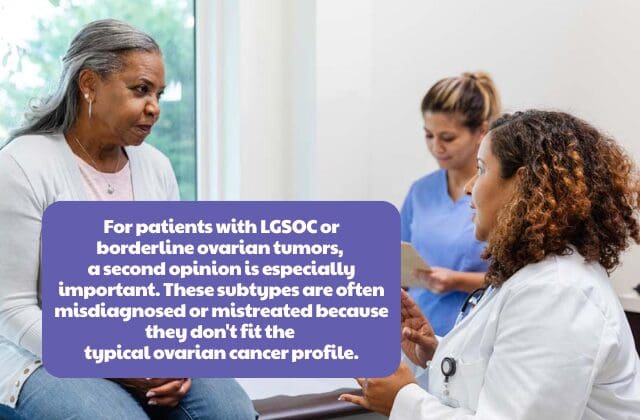
For patients with LGSOC or borderline ovarian tumors, a second opinion is especially important. These subtypes are frequently misdiagnosed or mistreated because they don’t fit the typical ovarian cancer profile. Seeking care at a major cancer center, or at least having your case reviewed by a specialist who has seen many cases like yours, can genuinely change your treatment path.
When you go for a second opinion, bring everything: pathology slides if possible, imaging discs, reports, and your updated list of questions.
9. See a gynecologic oncologist, not just a general oncologist
This is one of the most impactful decisions a patient can make. Gynecologic oncologists are specialists in cancers of the female reproductive system. They’re not just oncologists who sometimes see ovarian cancer; they focus on it.
The difference in surgical expertise, treatment planning, and familiarity with subtypes like LGSOC and borderline tumors is significant.
If you haven’t already been referred to one, ask for that referral. And when it comes to finding the right gynecologic oncologist, experience with your specific subtype matters.
10. Push beyond standard of care if your situation calls for it
Standard of care represents the established protocol for most patients in most situations. It’s based on strong data, and for many people, it’s exactly the right plan. But it’s a starting point, not a ceiling.
If you want to explore ovarian cancer clinical trials, ask about it. If you’re interested in whether a specific drug combination might be relevant to your case, bring it up. If you feel like you need additional testing, say so.
This is especially relevant for LGSOC and borderline tumor patients. Standard chemotherapy protocols developed for high-grade ovarian cancer are often less effective for LGSOC. Newer targeted options represent real progress, but you may need to ask specifically about them. Your doctor may be open to approaches that aren’t automatically offered.
Practical Day-to-Day Advocacy
Self-advocacy doesn’t only happen in clinical settings. Some of the most meaningful things you can do happen outside the hospital, in ordinary moments of treatment and recovery.
11. Manage the small things that affect your quality of life
Chemotherapy side effects are real and disruptive, and there are specific, practical strategies that can help, most of which you won’t be handed in a pamphlet.
A few things that ovarian cancer patients have found genuinely useful according to the below side effects:
- Metallic taste from chemo: Try wooden or bamboo cutlery instead of metal utensils. Use a water bottle with a fruit infuser to make plain water more tolerable.
- Neuropathy: Ask your care team about cold mittens and cold booties during infusion. Some patients pack them in dry ice and put them on before treatment starts.
- Constant coldness during treatment: An oversized blanket you bring yourself makes a real difference (you don’t have to rely on the hospital’s supply).
- Hospital overnight stays: Pack your own pajamas. Wearing your own clothes instead of a hospital gown can do a lot to protect your sense of self during treatment. You’re still you.
12. Be honest with your support network about what you actually need
Help comes in different forms: logistics, emotional support, practical tasks. The people around you want to help but often don’t know how. Being specific about what you need and what you don’t makes the support you receive more useful, and protects your relationships at the same time.
Some people want to talk about their diagnosis constantly. Others want someone to sit with them and watch television and pretend everything is normal for an hour. Both are valid. But the people around you can’t guess which one you need on any given day.
Advocacy That Goes Further
Beyond managing your own care, there are ways to build a broader foundation of support and to stay engaged with your health over the long term.
13. Join a support group, particularly one for your subtype
An ovarian cancer support group does something that even the best doctor can’t: it connects you with people who have actually lived what you’re living. They can tell you which questions to ask, what side effects to anticipate, what helped them navigate a recurrence, what a specific procedure actually felt like.
For LGSOC and borderline ovarian tumor patients, finding a subtype-specific community is worth the extra effort. Because these cancers are rarer, patients often feel isolated — diagnosed with something many people haven’t heard of, including some providers. Connecting with others who share your diagnosis is grounding in a way that’s hard to overstate.
14. Keep tracking your symptoms throughout treatment — not just before diagnosis
Once treatment begins, the work of self-advocacy doesn’t stop. Keep a simple log of how you feel during and after each treatment cycle. Note side effects, their severity, and how long they last.
This gives your care team accurate, timely information rather than your best recollection three weeks later. It also helps you identify patterns: which days are hardest, what seems to trigger a difficult response, what helps.
Ovarian cancer recurrence is a real possibility, especially for LGSOC patients who may manage the disease long-term. Staying actively engaged in monitoring your own health throughout treatment means you’re better positioned to notice changes early, and to speak up the moment something is off.
Build Self-Advocacy Over Time
Self-advocacy is not a single conversation. It’s a practice, something you build over time, one question asked, one record requested, one second opinion sought. And it gets easier.
The goal isn’t to become a medical expert; it’s to become an active participant in your own care, someone who knows when to push, when to ask, and when to seek another perspective. That shift alone can make a real difference in the treatment you receive and the outcomes you achieve.