
Beyond Treatment: Exercise and Ovarian Cancer Recovery, Explained
August 6, 2026

Nobody hands you a manual for this part of your ovarian cancer journey.
You finish surgery. You finish chemo, or you’re partway through it. And somewhere between the scan appointments and the port flushes, a question: what am I supposed to be doing with my body now?
Your oncologist is focused on the disease, understandably so. But the questions about movement and food (Can I lift things? Is walking safe yet? Why does everything taste like a handful of coins?) tend to fall through the cracks. So people turn to the Internet, find a wall of contradictory advice, and end up more anxious than when they started.
This article is part of our Beyond Treatment series on ovarian cancer survivorship, where we tackle the parts of life after diagnosis that clinical appointments rarely cover. Here, that’s exercise, nutrition, and recovery.
Exercise and ovarian cancer is a pairing that makes a lot of patients nervous. We’ve covered eating in depth in our ovarian cancer diet guide, so this one focuses on movement and the practical, do-it-today version of everything else.
Sign up to receive vital updates through email, and learn how you can get involved. "*" indicates required fieldsStay informed
First, an Honest Word About the Evidence
You’ll see confident claims online about exercise routines and foods that “fight” ovarian cancer. Be careful with those.
A 2026 review looked at the available studies on nutrition and exercise in ovarian cancer and found genuinely promising signals alongside genuinely contradictory ones. Some studies show survival benefits. Others show none. The authors concluded that randomized controlled trials are still needed to pin down what actually works and for whom.
The PADOVA randomized trial makes the same point. Researchers gave 81 patients a supervised exercise and diet program during chemotherapy for ovarian cancer, then compared them to patients receiving usual care.
The results leaned in the right direction. More women in the program received at least 85% of their planned chemotherapy dose, which matters because reduced doses can affect outcomes.
And at one specific time point, 18 months, 73% of the program group showed no signs of the cancer progressing, compared with 51% of the usual care group. That single snapshot is the most flattering number the trial produced, and it isn’t the same thing as the overall progression-free survival result.
But here’s the catch: the study was small, and neither result reached statistical significance. That 88% figure you may see quoted is narrower than it sounds. It’s the probability that more women in the exercise-and-diet group hit at least 85% of their planned chemotherapy dose than in the usual care group. It is not the probability that the program helped overall. The authors themselves are clear that the trial did not demonstrate a significant benefit.
So here’s the honest framing. Exercise and food are not treatments. They will not cure your cancer, and anyone selling you that is selling you something. What they can do is help you feel stronger, tolerate treatment better, and recover faster.
Exercise After Ovarian Cancer: 6 Ways to Rebuild Without Wrecking Yourself
These six approaches are about rebuilding capacity gradually instead of testing it.
1. Start smaller.
The single most common mistake is going too hard on a good day and paying for it later.
Start with a walk to the end of the street. Or up and down one flight of stairs. Gentle movement can also stimulate appetite, which makes it do double duty.
2. Know the number, then break it up
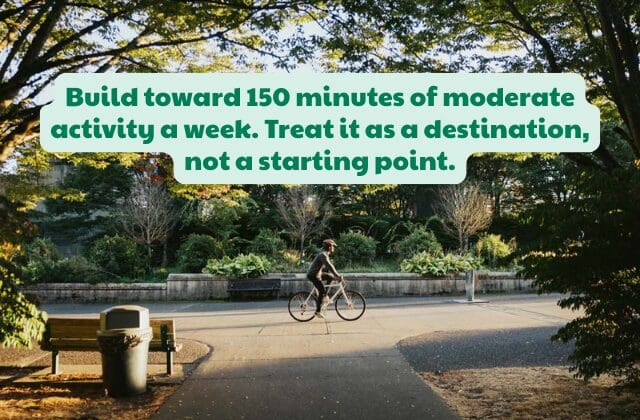 The American Cancer Society recommends building up to at least 150 minutes of moderate activity or 75 minutes of vigorous activity per week, plus muscle strengthening on 2 or more days per week.
That number sounds daunting until you split it. Thirty minutes, three times a week, gets you close to a meaningful threshold. Research presented at OCRA’s national conference found that 1.5 hours per week of moderate-intensity exercise (brisk walking counts) correlated with a 33% lower risk of mortality in years one through four after diagnosis, compared with women doing less than 30 minutes weekly.
3. Move during chemo, not just after it
This surprises people, but exercising through treatment appears to matter.
In one study, ovarian cancer patients doing higher-intensity exercise during chemotherapy reported better quality of life and were significantly less likely to have moderate-to-severe clinician-reported neurotoxicity (OR 0.50, 95% CI 0.29–0.88) than minimal exercisers. Given how disruptive chemotherapy-induced neuropathy is, that’s worth paying attention to.
Important note: clear it with your team first. Blood counts, ports, and fresh incisions all change what’s safe.
4. Add resistance training twice a week
This is the piece most survivorship advice skips, and it matters enormously for our community.
Any premenopausal woman who has both ovaries removed enters menopause immediately — histology doesn’t change that. It’s simply more common among younger patients, including those with low-grade serous or borderline tumors, because more of them are premenopausal at diagnosis. That sudden drop in estrogen accelerates bone loss. Weight-bearing and resistance exercise is one of the few things that pushes back. Light weights, resistance bands, body-weight movements, or yoga twice a week.
Read more in our guides to surgery-induced menopause and menopause and osteoporosis.
5. Don’t skip the pelvic floor
Abdominal and pelvic surgery weakens core and pelvic floor muscles. That shows up later as incontinence, discomfort during sex, and back pain, and most women are never told it’s treatable.
It is. See our guide to what is pelvic floor therapy, and read about the wider recovery timeline in ovarian cancer post surgery.
6. Cancer-related fatigue: move more, not less
Cancer-related fatigue is not ordinary tiredness. It’s one of the most common complaints among ovarian cancer patients during and after treatment.
Aerobic activity like walking or cycling can genuinely make you feel less tired and less stressed during treatment, counter-intuitive as that sounds. Among the benefits of staying active are boosted energy and reduced fatigue.
On the food side, dietitian guidance is refreshingly low-effort:
- Keep easy-prep food within arm’s reach. Yogurt cups, instant oats, canned tuna or salmon, frozen vegetables, prepared meals.
- Don’t skip meals. Going long stretches without food makes fatigue noticeably worse.
- Front-load your caffeine. Keep coffee to the early part of the day and moderate the amount. Doing so protects your sleep.
- Stay hydrated. Dehydration masquerades as exhaustion more often than people realize.
And then the part nobody says out loud: pace yourself in advance, not in hindsight. For example, if you know Thursday is a chemo day, don’t schedule anything meaningful on Friday. Protect your energy.
Nutrition: 6 Things that Help
 Forget optimization. These six strategies are about getting enough of the right things into your body when treatment is actively working against your appetite, your taste buds, and your digestion.
7. Lower the bar during active treatment
During chemo, the goal isn’t optimal. The goal is enough.
Eating little and often is just as good as two or three large meals, and there are no rules about what to eat when. Cereal at 9 PM is fine. Custard for breakfast is fine.
If you’re only managing a few mouthfuls, make them count. Full-fat yogurt instead of low-fat. Add butter, olive oil, cream, peanut butter, or honey to what you’re already eating. Clinical dietitians call this food fortification, and it’s the opposite of everything women are usually told about eating.
8. Protein first, everything else second
Chemotherapy and surgical stress both accelerate muscle breakdown. Losing muscle is how people end up weak, fall-prone, and slow to recover.
One study following 591 women after primary ovarian cancer treatment found that higher protein intake was associated with better progression-free survival. Worth noting: the same study found no clear link to overall survival, so treat this as one more reason to eat well rather than a promise.
The researchers’ practical takeaway was simple. Don’t adopt eating patterns that cut protein-rich foods. Reach for eggs, fish, beans, lentils, Greek yogurt, tofu, nuts, and cheese. Protein shakes count, too.
If you want a number to aim at, ASPEN recommends 1.2 to 1.5 g of protein per kilogram of body weight per day for people with cancer: roughly 84 to 105 grams a day for someone weighing 70 kg (about 154 lbs).
Higher targets get thrown around, but the PRIME trial found that 2 g/kg/day simply wasn’t achievable in practice, even with individual dietitian counseling. So treat the higher figures with suspicion and the 1.2–1.5 range as a realistic goal, not a floor you’ve failed to reach.
9. Match the food to the side effect
This is where a little strategy pays off enormously. Different symptoms call for different foods:
- Metallic taste: Use plastic or wooden utensils. Add lemon, lime, mint, or fresh herbs. Try stronger-flavored or smoked foods.
- Mouth sores: Cool, soft, bland. Yogurt, smoothies, shakes. Skip citrus, tomato sauce, and anything with sharp edges like granola or hard pretzels.
- Nausea: Cold or frozen foods carry less smell. Ginger tea, plain biscuits, dry toast. Eat something small rather than nothing, because an empty stomach usually makes it worse.
- Diarrhea: Call your team before you reach for food fixes. Diarrhea during chemo isn’t just uncomfortable. If it’s severe or persistent, it can mean dose reductions, treatment delays, or hospitalization for dehydration, and your oncologist needs to know so they can manage it properly. Once they’ve assessed it, dietary support helps for mild cases: soluble fiber like oatmeal and bananas, well-cooked vegetables, and electrolyte fluids. Limit raw veg, fruit juice, and greasy food. But if you’re having frequent watery stools, waking overnight to go, or seeing blood, food is not the answer. Call for help.
- Constipation: Gradually add fiber (wholegrains, pears, prunes, lentils) and drink more water. Fiber without fluid makes constipation worse, not better.
10. Drink more water
Hydration affects fatigue, constipation, diarrhea, electrolyte loss, and how well your body handles chemo. Water counts, but so do herbal teas, sparkling water, milk, soups, and high-water fruits like watermelon and cucumber.
Adding cordial, lemon, or cucumber helps if plain water doesn’t taste good.
11. Be skeptical of supplements and superfoods
There is no scientific category called “superfoods.” Blueberries and broccoli are good for you the same way lots of plants are good for you, and neither has been shown to affect ovarian cancer growth in humans.
Turmeric is a similar story. Curcumin shows anti-cancer effects in the lab, but there’s no clear evidence it treats cancer in people, and some supplements are expensive and potentially harmful.
More importantly: some supplements interfere with treatment. High-dose antioxidants aren’t recommended during chemotherapy. Fish oil and St John’s Wort can interact with chemo drugs. Grapefruit interferes with the CYP3A4 enzyme that metabolizes many oral cancer drugs, which can push blood levels of those medications higher than intended.
It’s worth knowing why this matters so much. Dietary supplements are not evaluated by the FDA for safety or effectiveness before they reach the shelf, so what’s on the label isn’t guaranteed to be what’s in the bottle. NCCN’s guidance on supplements treats both toxicity and drug interactions as real, documented risks rather than theoretical ones. Always run supplements past your oncology team first.
12. Stop cutting entire food groups out of fear
You do not need to go sugar-free. Your cells need glucose, and if you don’t eat enough, your body starts breaking down protein and fat to make it. That means losing weight you can’t afford to lose.
The nuance: when you’re eating normally, NCCN suggests keeping added sugars under about 6 teaspoons per 2,000 calories, which is sensible general nutrition advice. When you’re three days into a cycle and ice cream is the only thing you can face, eat the ice cream. Calories you actually swallow beat calories you theoretically should have eaten. The guideline is for the good weeks.
There’s also no clear evidence linking dairy to ovarian cancer, so unless you’ve been specifically advised otherwise, cheese and milk are perfectly good sources of calcium and protein.
The Overlooked Variable: Sleep
 If you’re not sleeping well, you’re in the majority. The OPAL study found that more than a third of women with ovarian cancer were affected within three years of diagnosis: about 25% reported insomnia symptoms, and another 13% were using sleep medication.
It matters more than it gets credit for. Research that studied 460 ovarian cancer patients undergoing chemotherapy found that sleeping seven hours or less per day and taking fewer daily steps were both independently associated with longer hospital stays.
Sleep isn’t a soft extra. It’s just as important as exercise and food and it’s worth raising with your team rather than quietly enduring. If insomnia has taken hold, our guide to ovarian cancer and insomnia covers what actually helps, and stress management for cancer patients tackles the anxiety that often keeps you awake.
Ask for Referrals
Here’s another practical move that beats every tip above: get professionals involved.
Ask your GP or oncologist for a referral to an exercise physiologist or physiotherapist, especially after surgery. Ask about an oncology dietitian.
If you’re not sure how to push for it, our guide to self-advocacy ovarian cancer walks through exactly how to make the ask. And if you want people who understand the day-to-day of this, ovarian cancer support groups are where a lot of the most useful practical knowledge actually lives.
Common Questions about Exercise and Ovarian Cancer
These are the questions patients ask most often, and the ones that rarely get a straight answer in a fifteen-minute appointment.

Can you exercise during chemotherapy for ovarian cancer?
For most patients, yes, with your medical team’s approval. Research found that ovarian cancer patients who did moderate-to-vigorous exercise during chemotherapy reported better quality of life and were significantly less likely to experience moderate-to-severe neurotoxicity than minimal exercisers.
A conversation with your oncologist comes first.
How much exercise is safe after ovarian cancer surgery?
Start slowly and build gradually, even if you were very active before.
Your surgeon will clear you for activity and give you specific restrictions, and those vary a lot from person to person. Lifting limits, timelines, and what counts as “too much” depend on the type of incision, what was removed, and how your recovery is going. Follow their instructions over anything you read online, including this article, and ask for specifics if you’re sent home with vague advice. “Take it easy” is not a plan.
Within whatever restrictions you’re given, walking is usually the first thing back on the table. From there, work toward the general target of 150 minutes of moderate activity per week, but treat that as a destination rather than a starting point. A physiotherapist or exercise physiologist can build a plan around your specific surgery, and the recovery timeline in our guide to ovarian cancer post-surgery gives you a sense of what to expect along the way.
Does exercise reduce ovarian cancer recurrence?
The honest answer is that we don’t know, and the evidence is messier than most articles admit.
Observational studies have found associations between physical activity after diagnosis and lower mortality. But the PADOVA trial is a genuine caution: the 18-month progression-free numbers looked better in the exercise and diet group, yet the overall progression-free survival analysis did not favor the intervention. The hazard ratio actually pointed toward the control group.
That’s the kind of inconsistency that should make anyone skeptical of confident claims in either direction. Exercise clearly improves strength, fatigue, and quality of life, and that alone is reason enough to do it. Whether it changes recurrence risk remains an open research question.
Eat, Move, and Rebuild Strength During and After Ovarian Cancer
You cannot exercise your way out of ovarian cancer. But you can move and eat in ways that make treatment more tolerable, recovery faster, and daily life more like your own.
Start walking. Add light resistance work twice a week. Prioritize protein and hydration. Protect your sleep. Ask for a referral. Ignore anyone promising a cure in a supplement bottle.
And go easy on yourself about the days it doesn’t happen. Some weeks you’ll manage the walk and the balanced meals and the early bedtime. Other weeks you’ll manage toast. Both are fine. This isn’t a test you pass or fail, and consistency over months matters far more than any single day.
Always talk to your healthcare team before making significant changes to your diet or activity level. What’s right for you depends on your treatment, your surgery, and your body.