
Ovarian Cancer Prevention: What You Can (and Can't) Do to Reduce Your Risk
March 9, 2026

Ovarian cancer prevention is one of the most searched — and most misunderstood — topics in women’s health. And it’s understandable why.
When someone you love is diagnosed, or when a doctor mentions you may be at elevated risk, the first thing most people want to know is: what can I do?
Here’s what the science actually says: there is no guaranteed way to prevent ovarian cancer. But there are real, meaningful steps that can significantly lower your risk, and knowing which ones apply to your situation could matter more than you think.
This guide is for anyone who wants to understand the options clearly, without the false hope or the unnecessary fear.
Sign up to receive vital updates through email, and learn how you can get involved. "*" indicates required fieldsStay informed
Why Ovarian Cancer Is So Hard to Prevent
Most cancers we talk about preventing have a clear target. Quit smoking, reduce lung cancer risk. Use sunscreen, reduce skin cancer risk. Ovarian cancer doesn’t work quite so neatly.
Part of the challenge is that ovarian cancer is actually a group of distinct diseases, not one single disease. The most common and deadliest type, high-grade serous carcinoma (HGSOC), is now understood to have dual origins. Most cases appear to begin in the fallopian tubes, but emerging research suggests a subset may originate in the ovarian surface epithelium itself, a distinction that may ultimately influence treatment selection. Other subtypes have different biological origins entirely. That complexity makes a one-size-fits-all prevention approach impossible.
Add to this the fact that most women are diagnosed at an advanced stage (because early-stage ovarian cancer rarely causes obvious symptoms) and the urgency of understanding risk becomes very real.
Know Your Risk Factors First
 Before talking about what you can do, it helps to understand what puts someone at higher risk. You can’t change all of these, but you can try to get a better understanding of these ovarian cancer risk factors.
- Genetic mutations are among the most significant risk factors. Women with a BRCA1 gene mutation have a 35 to 70% lifetime risk of developing ovarian cancer; those with BRCA2, an estimated 10 to 30% risk. Mutations in Lynch syndrome genes also substantially increase risk. (Learn more about BRCA testing for ovarian cancer.)
- Family history matters even without a known mutation. Having a first-degree relative (mother, sister, or daughter) with ovarian cancer meaningfully raises your risk. So does a family history of breast or colorectal cancer.
- Reproductive history plays a role, too. Women who have never been pregnant, who started menstruating early, or who went through menopause late have more cumulative ovulatory cycles, and research suggests this is linked to higher risk for some ovarian cancer types.
- Endometriosis is associated with an increased risk, particularly for clear cell and endometrioid subtypes. Read more about the connection between endometriosis and ovarian cancer.
- Hormone replacement therapy (HRT) after menopause has been associated with a modest increase in risk, particularly with long-term use of estrogen alone or estrogen combined with progestin.
- Obesity is also a risk factor, especially for postmenopausal women.
Other factors — including Ashkenazi Jewish ancestry (which carries higher rates of BRCA mutations) — are also relevant, though it’s worth noting that BRCA mutations specifically increase risk for HGSOC, not low-grade serous ovarian cancer.
Knowing your risk profile is the foundation of any smart prevention conversation with your doctor. It’s also why genetic testing — from BRCA screening to broader multigene panel testing — has become one of the most powerful tools available to women who want to understand and act on their ovarian cancer risk.
Strategies That Can Help With Preventing Ovarian Cancer
None of these are absolute guarantees. They’re risk-reduction strategies, not prevention in the truest sense. But each has meaningful evidence behind it.
Oral Contraceptives
This is one of the most consistent findings in ovarian cancer research: women who have used oral contraceptives (birth control pills) have a significantly lower risk of developing ovarian cancer.
According to the National Cancer Institute, women who have ever used oral contraceptives have a 30 to 50% lower risk compared to those who have never used them, and that protection increases with longer duration of use.
Even more striking: that protective effect can persist for up to 30 years after a woman stops taking the pill.
The most widely cited theory is relatively straightforward: oral contraceptives suppress ovulation, and the fewer times a woman ovulates over her lifetime, the lower her exposure to the hormonal and cellular processes associated with certain ovarian cancer subtypes.
But that may not be the whole story. Some researchers believe oral contraceptives may also induce lasting changes to the ovarian or fallopian tube epithelium: a kind of semi-permanent biological shift that could help explain why the protective effect persists for decades after a woman stops taking the pill. The exact mechanism is still unclear, and research is ongoing.
This benefit also extends to women with BRCA1 gene mutations, for whom ovarian cancer risk is especially high.
That said, oral contraceptives are not without trade-offs. They are associated with a modest increase in breast cancer risk and carry other risks like blood clots, particularly in smokers. This is a decision to make with your doctor, not based on a general recommendation.
Pregnancy and Breastfeeding
Women who have carried at least one pregnancy to term have a lower risk of ovarian cancer than women who have never been pregnant. And the more pregnancies, the lower the risk. Having a first full-term pregnancy before age 26 is particularly associated with risk reduction.
Breastfeeding also appears to offer some protection: the longer the duration, the greater the effect. The leading hypothesis is similar to that of oral contraceptives: breastfeeding suppresses ovulation, reducing cumulative ovulatory cycles.
Of course, pregnancy and breastfeeding are life choices — not medical interventions. No one should approach them as cancer prevention tools. But they’re worth noting for what they tell us about the biology of ovarian cancer.
Surgical Options: The Evolving Story of the Fallopian Tubes
 This is where ovarian cancer prevention science has made some of the most meaningful advances in recent years and where the conversation is shifting in important ways.
Opportunistic Salpingectomy
Research now suggests that a significant portion of the most lethal form of ovarian cancer — high-grade serous carcinoma — actually originates in the fallopian tubes, not the ovaries themselves.
This has led to growing interest in opportunistic salpingectomy: the removal of the fallopian tubes at the time of another planned pelvic surgery, even for women who have no family history of ovarian cancer.
The procedure doesn’t remove the ovaries, so it doesn’t cause menopause. And because the fallopian tubes have no meaningful function after a woman has completed childbearing, the procedure carries relatively little downside for the right candidates.
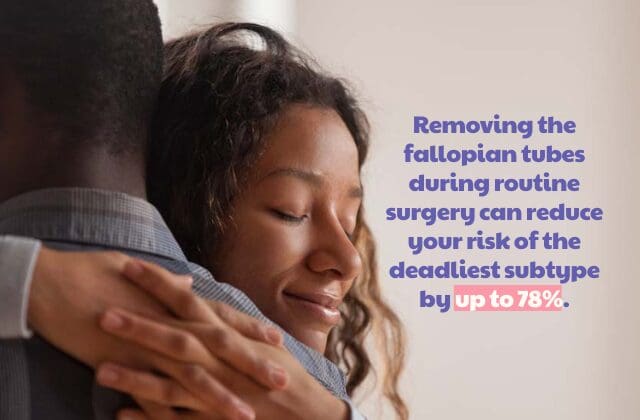
A landmark study analyzing health data from more than 85,000 women found that those who had their fallopian tubes removed during routine gynecological surgery were 78% less likely to develop serous ovarian cancer.
Traditionally, opportunistic salpingectomy has been performed by gynecologists during procedures like tubal ligation or hysterectomy. But there’s a growing push to expand that conversation — some researchers and clinicians are now advocating for general surgeons to consider performing the procedure during unrelated abdominal surgeries, such as a cholecystectomy (gallbladder removal), as an additional cancer prevention measure for appropriate patients.
Tubal Ligation
“Getting your tubes tied” has long been associated with a reduced risk of certain ovarian cancer types.
Studies suggest the risk reduction ranges from 25 to 65%, though researchers don’t fully understand all the mechanisms. According to research on tubal ligation and ovarian cancer, the protective effect appears strongest for endometrioid cancers.
It’s worth noting that many experts now prefer recommending full salpingectomy over tubal ligation precisely because tube removal provides broader protection.
Hysterectomy
Women who have had a hysterectomy (removal of the uterus) also show a reduced risk of certain ovarian cancer types, potentially around 33% lower risk. But hysterectomy is not recommended as a standalone ovarian cancer prevention strategy unless there is an independent medical reason for the procedure.
Risk-Reducing Surgery for High-Risk Women
For women with BRCA1, BRCA2, or Lynch syndrome gene mutations, the calculus changes significantly. These women face a substantially elevated lifetime risk, and prophylactic bilateral salpingo-oophorectomy (removal of both the ovaries and fallopian tubes) is often recommended once they have completed childbearing.
This surgery can reduce ovarian cancer risk by up to 80 to 95%. But it’s a major decision. For premenopausal women, it brings on surgical menopause immediately, with all the associated effects on bone density, cardiovascular health, mood, and sexual function. It also ends any possibility of natural conception.
This is a conversation that belongs in the hands of a gynecologic oncologist who specializes in hereditary cancer risk. Learn more about oophorectomy surgery and what recovery looks like.
What Doesn’t Clearly Help
Some things are often mentioned in connection with ovarian cancer prevention but have limited or inconclusive evidence:
Diet: No specific dietary pattern has been consistently linked to lower ovarian cancer risk, though eating well has broad health benefits. The research on individual foods and supplements is largely inconclusive.
Exercise: Physical activity is associated with a lower risk of many cancers, and maintaining a healthy weight likely reduces ovarian cancer risk as well. But the relationship between exercise specifically and ovarian cancer is not yet clearly established.
Talcum powder: For years, some studies suggested a link between perineal talc use and ovarian cancer. The current scientific consensus is that the evidence is inconsistent and not definitive. Most products no longer contain talc, and women shouldn’t panic over past use.
Aspirin and NSAIDs: Some studies have shown modest reductions in ovarian cancer risk with regular aspirin use; others have not. This isn’t a recommended prevention strategy at this time.
The Role of Genetic Counseling and Testing
If there’s one action that can meaningfully change the conversation for high-risk women, it’s this: getting genetic counseling and testing.
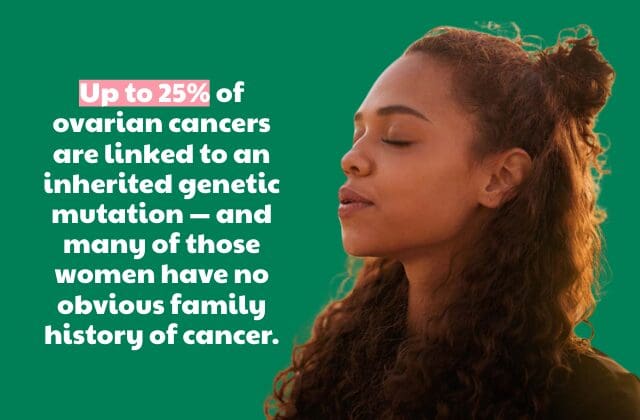
Up to 25% of ovarian cancers are associated with an inherited genetic mutation, yet a significant number of women with these mutations have no obvious family history of cancer.
That’s not a contradiction; it’s a reminder that waiting for a “red flag” family history before considering testing can mean missing an important window.
Genetic counseling helps you understand what testing can and can’t tell you, and what the results would mean for your health decisions, including whether prophylactic surgery makes sense, what surveillance is appropriate, and how to share this information with family members who may also carry a mutation.
BRCA testing and broader multigene panel testing are becoming more accessible and are often covered by insurance. If your family history includes ovarian, breast, or colorectal cancer — or if you have Ashkenazi Jewish ancestry — a conversation with a genetic counselor is worth having.
A Note on Ovarian Cancer Screening
One important thing to understand: there is currently no reliable ovarian cancer screening test for the general population. The CA-125 blood test and transvaginal ultrasound are tools used in monitoring, not diagnosis for average-risk women. Neither has been shown to reduce mortality in the general population.
This is a critical gap — and it’s one of the reasons that early detection research is so urgently needed. At Not These Ovaries, this is central to our mission.
How to Prevent Ovarian Cancer: The Honest Summary
There is no single answer to how you prevent ovarian cancer. What there is:
- A clearer understanding than ever before of what raises and lowers risk
- Surgical options — especially fallopian tube removal — that carry real protective benefits
- Genetic testing that can identify high-risk women before cancer appears
- Birth control pills with a meaningful, well-documented protective effect for appropriate candidates
- And an urgent, ongoing need for more research
If you’re concerned about your risk, the most important thing you can do is talk to a gynecologic oncologist or genetic counselor who specializes in this area. And if you want to support the research that’s working toward better answers — including for the underresearched subtypes like LGSOC and borderline tumors — you can do that, too. Remember: action and understanding will save lives.