
The Meaning of Being an Ovarian Cancer Previvor
September 14, 2026

An ovarian cancer previvor is someone who carries a known, elevated risk of ovarian cancer but has never been diagnosed with the disease.
Previvorship can be discovered through a genetic test result or a family history, and it creates a future that demands decisions most women never have to make.
Here’s what matters: being an ovarian cancer previvor gives you something almost no ovarian cancer patient gets: time. Ovarian cancer is usually caught late, after ovarian cancer symptoms have been dismissed for months. Previvors have the opportunity to move first.
What Is a Cancer Previvor?
The term “previvor” was coined by the advocacy community, not by clinicians, and that origin tells you something. It came from patients who needed a word for their own experience.
A previvor is a person with an elevated predisposition to cancer. They may carry an inherited pathogenic mutation, have a family history that puts them in a high-risk category, or have another documented factor that raises their odds well above the general population’s.
Roughly 5% to 10% of all cancers are hereditary. For ovarian cancer specifically, the proportion is higher: up to a quarter of cases are linked to an inherited mutation.
Sign up to receive vital updates through email, and learn how you can get involved. "*" indicates required fieldsStay informed
Not Everyone Wants the Label
Some women embrace “previvor” immediately. It names an experience that otherwise gets minimized, and it connects them to a community that understands why a routine ultrasound can feel like a verdict.
Others reject it. For them, the word makes cancer sound scheduled, like something already on the calendar waiting to be confirmed. That’s a legitimate response, too.
You do not have to adopt the term to use the medical care that comes with it. Call yourself whatever you want. Get the screening anyway.
What Makes Someone an Ovarian Cancer Previvor
 Most ovarian cancer previvors learn their status through genetic testing. A blood or saliva sample identifies inherited changes in genes that normally help repair damaged DNA.
BRCA1 and BRCA2 are the best known. According to research, about 39% to 58% of women with a harmful BRCA1 variant and 13% to 29% of women with a harmful BRCA2 variant will develop ovarian cancer (including fallopian tube and primary peritoneal cancer) in their lifetime. Compare that to the general population: the American Cancer Society puts a woman’s lifetime risk at roughly 1 in 91.
That gap is the entire reason previvor care exists.
Lynch syndrome, caused by mutations in mismatch repair genes like MLH1, MSH2, MSH6, PMS2, and EPCAM, also raises ovarian cancer risk. But how much it raises that risk depends almost entirely on which gene is involved, and the major bodies don’t land on the same number.
ACOG puts the lifetime ovarian cancer risk for Lynch carriers at 4% to 24%. A JAMA analysis reports 10% to 18% for women with mismatch repair mutations. NCCN goes gene by gene: 4% to 20% for MLH1 carriers and 8% to 38% for MSH2 carriers.
Those ranges are wide, and they don’t overlap cleanly. It reflects how much a single gene can shift the picture. Knowing you have “Lynch syndrome” tells you far less than knowing you carry a specific MSH2 variant. Our full breakdown of Lynch syndrome and ovarian cancer covers the gene-by-gene numbers.
Other genes matter, too. BRIP1, RAD51C, RAD51D, PALB2, and ATM all carry documented inherited ovarian cancer risk. Ten years ago, many panels didn’t include them. Today they do, which means research matters.
Family history alone can qualify you, even without a confirmed mutation. If ovarian cancer, early breast cancer, or colorectal cancer runs through your family, that pattern counts. Learn more about the full picture of how germline mutations in ovarian cancer are inherited.
How Doctors Manage Ovarian Cancer Previvors
Here’s the uncomfortable truth at the center of previvor care: there is no reliable early detection for ovarian cancer: not for previvors, not for anyone.
Transvaginal ultrasound can spot a mass but can’t tell you whether it’s cancer. The CA125 ovarian cancer screening test measures a protein that rises in ovarian cancer, but also in endometriosis, fibroids, pelvic inflammatory disease, and normal menstruation. Neither test, alone or combined, has been shown to reduce ovarian cancer mortality in the general population.
So what do clinicians actually do?
Genetic counseling comes first. A certified genetic counselor reviews your family tree, orders the right panel, and translates the result.
This matters more than people expect. Results are not always binary. A “variant of uncertain significance” means the lab found a change it can’t yet classify, and those variants get reclassified over time, sometimes years later.
Dedicated previvor clinics are emerging. Cedars-Sinai runs a BRCA Ovarian Previvor Clinic specifically for BRCA1 and BRCA2 positive patients between 30 and 50. A typical visit runs about an hour and includes a medical and family history review, examination of prior genetic tests, a transvaginal ultrasound, a pelvic exam, and a blood draw that includes CA125. Most patients return every six months.
Surveillance is a stopgap, not a solution. Gynecologic oncologists are candid about this. Regular monitoring buys reassurance and catches some cancers earlier, but it does not replace risk reduction.
How to Manage Your Risk as an Ovarian Cancer Previvor
 Ovarian cancer previvors generally have three levers: monitoring, medication, and surgery.
Surveillance
Scheduled ultrasounds, CA125 draws, pelvic exams, and symptom tracking. Imperfect, but not worthless, especially for younger previvors who aren’t ready for surgery.
Preventive Medication
Oral contraceptives are the most studied preventive medication. Long-term use is associated with roughly a 50% reduction in ovarian cancer risk, and research found a protective effect in women with BRCA mutations as well.
The protection appears to persist after stopping. Oral contraceptives carry their own risks, so this is a conversation with your doctor, not a decision to make alone.
Risk-Reducing Surgery
This is the most effective option available. Risk-reducing salpingo-oophorectomy (removal of both fallopian tubes and ovaries) reduces ovarian cancer risk by an estimated 80% to 95%, according to research.
NCCN guidance recommends the procedure between ages 35 and 40 for BRCA1 carriers, 40 to 45 for BRCA2 carriers, and 45 to 50 for those with BRIP1, RAD51C, or RAD51D variants. For Lynch syndrome, timing is individualized by variant.
One thing to note for premenopausal women: this surgery triggers immediate surgery-induced menopause, with consequences for bone density, cardiovascular health, sexual function, and sleep.
Salpingectomy with delayed oophorectomy is the alternative gaining ground. Because most high-grade serous ovarian cancers appear to originate in the fallopian tubes rather than the ovaries, removing the tubes first (and the ovaries later) may preserve hormone function while still cutting risk substantially.
Read more about opportunistic salpingectomy and the emerging evidence behind it. If you’re weighing surgical options, our comparison of oophorectomy vs hysterectomy and our guide to oophorectomy surgery break down what each procedure actually involves.
Fertility Planning
For previvors in their twenties and thirties, this is often the deciding factor. Oocyte cryopreservation before risk-reducing surgery lets women preserve the option of biological children.
The Blind Spot for Low-Grade Serous and Borderline Previvors
Almost everything above was built around germline mutations, or inherited mutations like BRCA, and high-grade serous disease.
But low-grade serous ovarian cancer (LGSOC) and borderline ovarian tumors don’t follow the same rules. They’re driven largely by somatic mutations, like MAPK pathway alterations like KRAS and BRAF. They strike younger women, with a median age around 45. And there is no established previvor pathway for them, because the hereditary risk profile isn’t well characterized yet.
That means a woman with a strong family history of LGSOC may not find her risk reflected in any standard screening protocol. She’s a previvor without a playbook.
This gap is precisely why Not These Ovaries funds research into these subtypes. Understanding what precedes low-grade serous ovarian cancer and borderline ovarian cancer is the first step toward giving these women the same preventive options BRCA carriers have today. Our overview of genetic testing for LGSOC covers what’s known so far.
Where Ovarian Cancer Previvors Find Support
The emotional weight of previvorship is routinely underestimated. Women describe anxiety before every scan, guilt, and loneliness. Support options worth knowing:
- FORCE (Facing Our Risk of Cancer Empowered) is the largest organization built specifically for hereditary cancer previvors, with peer navigation, message boards, and research advocacy.
- Genetic counselors provide ongoing support, not just a one-time result. Many previvors don’t realize they can go back.
- Ovarian cancer organizations including OCRA and the National Ovarian Cancer Coalition run programs open to high-risk women, not only patients.
- Peer connection matters most for the specific decisions, especially surgical timing and fertility. Our directory of ovarian cancer support groups is a good starting point.
- Mental health professionals with oncology experience understand scanxiety and decision fatigue in ways general practitioners often don’t.
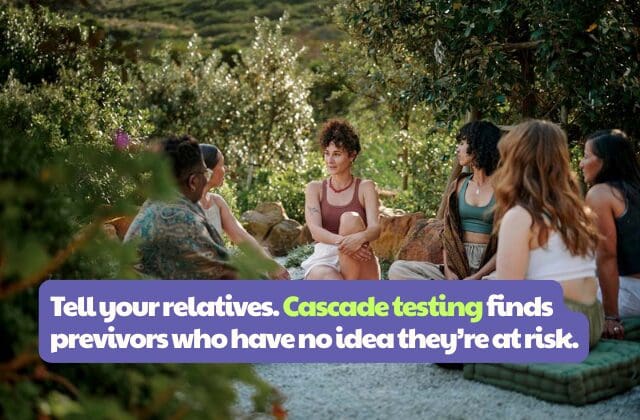
Tell your family, too. Cascade testing, where relatives of a mutation carrier get tested, identifies other previvors who have no idea they’re at risk. It’s frequently covered by insurance.
Questions Every Ovarian Cancer Previvor Should Ask
Bring these to your genetic counselor, gynecologic oncologist, or previvor clinic visit.
About your specific risk
- Which exact gene and variant do I carry, and what is my lifetime ovarian cancer risk with that specific variant?
- Could my result be reclassified later, and how will I be notified if it is?
- Does my family history change my risk estimate beyond what the gene alone suggests?
About screening
- What surveillance do you recommend for me, and what are its documented limitations?
- Which symptoms should prompt me to call you immediately rather than wait for my next appointment?
- Are there fallopian tube lesions or precursor findings you’d be watching for?
About risk reduction
- Based on my variant and my age, when should I be considering risk-reducing surgery?
- Am I a candidate for salpingectomy with delayed oophorectomy?
- Would oral contraceptives or another medication option make sense for me?
- If I have surgery, what’s the plan for managing menopause afterward, and is hormone therapy an option in my case?
About fertility and family
- If I want children, how does that change the timeline?
- Should I meet with a fertility specialist before making surgical decisions?
- Which relatives should be tested, and how do I approach that conversation?
About cost and logistics
- Is genetic testing and ongoing surveillance covered by my insurance?
- Are there clinical trials for high-risk women I could join?
Our broader list of ovarian cancer questions to ask your doctor covers additional ground worth reviewing.
Knowledge Is the Intervention
For most of medical history, an inherited cancer risk was something you found out about only after the cancer arrived. That’s changed. Genetic testing turned a hidden inheritance into actionable information, and every ovarian cancer previvor is proof of what that shift makes possible.
But the tools are still incomplete.
What every ovarian cancer previvor can control is the quality of the information they’re working from: a genetic counselor who explains your specific variant instead of a general category. A gynecologic oncologist who treats your risk as an ongoing conversation. A family that knows what runs through it.
If any of this sounds like you or someone in your family, take one step this week. Request the referral. Book the appointment. Ask your relatives what they actually know about the cancers in your family tree. You can’t change what you inherited. You can change what you do about it.