
A Quick Guide on Rare Ovarian Cancer Subtypes
April 9, 2026

Rare ovarian cancer subtypes are more common than most people realize. But they are also far less understood than they should be.
If you or someone you love has just received a diagnosis that isn’t the “typical” high-grade serous ovarian cancer, you may already be discovering how isolating that experience can feel. The information is harder to find. The specialists are fewer. And the research? Still catching up.
But here’s what matters most: your diagnosis is real, it is valid, and you are not alone.
Ovarian cancer is not a single disease. It’s a collection of distinct diseases, each with its own biology, behavior, and treatment profile. Understanding which subtype you’re dealing with isn’t just useful. It can be the difference between a treatment plan that works and one that doesn’t.
Sign up to receive vital updates through email, and learn how you can get involved. "*" indicates required fieldsStay informed
What Makes an Ovarian Cancer Subtype “Rare”?
Most people are familiar with high-grade serous ovarian cancer (HGSOC), which accounts for roughly 70% of all ovarian cancer diagnoses. It is the most common subtype and the one most often represented in awareness campaigns.
The World Health Organization classifies ovarian cancer into three primary groups based on cell origin:
- Epithelial tumors (the most common)
- Germ cell tumors
- Sex cord-stromal tumors.
About 85 to 90% of malignant ovarian cancers are epithelial ovarian carcinomas. Within that majority, high-grade serous is the dominant subtype. The remaining 10–15% consist of germ cell tumors, sex cord-stromal tumors, and less common epithelial subtypes. These are generally considered “rare” ovarian cancers.
Unfortunately, this means every other subtype exists in its shadow, often receiving less research funding, fewer dedicated clinical trials, and less awareness overall. That funding gap has real consequences for patients: fewer clinical trials, fewer FDA-approved treatment options, and often a longer, harder road to the right diagnosis.
Important note: The percentages used throughout this guide refer to different subsets of ovarian cancer (for example, all ovarian cancers vs. only epithelial cancers). Because of this, they are not meant to be added together directly.
The Three Main Categories of Rare Ovarian Cancer
Each category differs in where the cancer originates, who it tends to affect, and how it behaves, which is why understanding the distinctions matters.
Rare Epithelial Ovarian Cancers
Epithelial ovarian cancers arise from the cells lining the ovaries or fallopian tubes. While high-grade serous ovarian cancer makes up the majority, several less common epithelial subtypes fall outside of that group. Together, these rarer epithelial cancers make up a minority of the 85 to 90% epithelial category, and each behaves differently in terms of prognosis and treatment.
Low-Grade Serous Ovarian Cancer (LGSOC)
 This is one of the two subtypes at the heart of Not These Ovaries’ mission. LGSOC is a slow-growing, often chemotherapy-resistant form of epithelial ovarian cancer that primarily affects younger women.
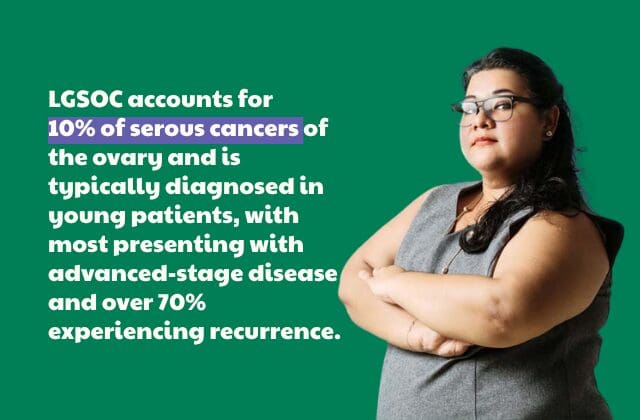
Low-grade serous carcinoma accounts for 10% of serous cancers of the ovary and is typically diagnosed in young patients, with most presenting with advanced-stage disease and over 70% experiencing recurrence. Low-grade serous carcinoma accounts for about 10% of serous ovarian cancers, making it a relatively small fraction of ovarian cancers overall.
Unlike HGSOC, LGSOC cells look more similar to normal tissue under a microscope. But that relative “normalcy” doesn’t make it easier to treat. In fact, its resistance to standard chemotherapy is one of its defining challenges.
Surgery is the cornerstone when it comes to treating LGSOC. It is not optional, but rather a critical first step. The goal is to remove as much of the visible tumor as possible, as other treatments won’t work as effectively without tumor removal. This could mean a major surgery to debulk the cancer, a fertility-saving surgery for younger patients, or a second surgery if the cancer comes back.
Borderline Ovarian Tumors (BOT)
Also called tumors of low malignant potential, borderline ovarian tumors occupy a unique and often confusing space. They have characteristics that resemble cancer under a microscope, but they typically don’t invade surrounding tissue the way malignant tumors do.
Borderline ovarian tumors make up about 15% of all ovarian neoplasms (which include both benign and malignant tumors). Unlike invasive ovarian cancers, BOTs are considered tumors of low malignant potential, meaning they typically do not invade surrounding tissue. They are often diagnosed early, with about 71% identified at Stage I or II, and have excellent long-term outcomes, with 10-year survival rates of 96–99%.
But “borderline” doesn’t mean “nothing to worry about.” Recurrence is possible, and accurate pathology is critical.
Mucinous Ovarian Carcinoma
Mucinous ovarian carcinoma is frequently misdiagnosed because it can closely resemble cancers of the gastrointestinal tract.
Mucinous ovarian carcinoma accounts for approximately 5 to 10% of all ovarian cancers, although the true percentage may be lower due to frequent misclassification of metastatic gastrointestinal cancers as ovarian in origin.
It tends to be diagnosed at earlier stages and in younger women, and it often doesn’t respond as well to standard platinum-based chemotherapy. Gastrointestinal-type chemotherapy regimens have shown more promise in some retrospective studies, though large-scale clinical trials remain limited.
Clear Cell Carcinoma
Clear cell carcinoma represents approximately 5 to 10% of epithelial ovarian cancers.
Clear cell carcinoma is more commonly found in younger women and is frequently associated with endometriosis. Clear cell carcinoma has a good prognosis when caught and treated in the early stages, but advanced-stage disease tends to respond poorly to conventional chemotherapy.
Research into immunotherapy and targeted agents (particularly those addressing the PI3K/AKT/mTOR pathway) is ongoing and showing early promise.
Endometrioid Carcinoma
Endometrioid ovarian carcinoma is often caught at earlier stages, and most cases are low-grade. That said, grade 2 and grade 3 endometrioid tumors do exist, and the NCCN groups those higher grades alongside high-grade serous ovarian cancer for the purposes of systemic therapy. Like clear cell carcinoma, endometrioid carcinoma is linked to endometriosis in a significant portion of cases.
Endometrioid ovarian carcinoma accounts for about 10% of epithelial ovarian cancers and is associated with a better prognosis than many other subtypes.
Germ Cell Tumors
Ovarian germ cell tumors arise from egg-producing cells and account for less than 5% of all ovarian cancers. They are most commonly diagnosed in adolescents and young women. With modern chemotherapy (such as BEP), cure rates now approach 95%, representing a major improvement compared to historical outcomes.
The most common subtypes include:
- Dysgerminoma: the most common malignant germ cell tumor, histologically analogous to testicular seminoma, and highly responsive to treatment despite rapid growth
- Yolk sac tumor: tends to grow quickly and is associated with elevated AFP (alpha-fetoprotein) levels in the blood
- Immature teratoma: contains immature tissue and is graded by the degree of neural differentiation present
- Embryonal carcinoma: rare and aggressive, usually diagnosed in adolescents
- Nongestational choriocarcinoma: extremely rare; highly malignant and distinct from its placental counterpart
Because germ cell tumors often affect only one ovary, fertility-sparing surgery is frequently possible, an important consideration for the younger women most commonly diagnosed.
Sex Cord-Stromal Tumors
Sex cord-stromal tumors develop in the hormone-producing structural tissues of the ovary. They represent approximately 7% of all ovarian cancers. Because they often produce hormones (estrogen or androgens), they sometimes cause symptoms that look nothing like typical ovarian cancer: irregular periods, unexpected vaginal bleeding, or even signs of virilization like facial hair growth.
Those hormone-related signals can actually aid early detection, which is one reason many sex cord-stromal tumors are caught at Stage I.
Granulosa Cell Tumors (GCT)
Adult granulosa cell tumors comprise approximately 95% of GCTs and about 1% of all ovarian neoplasms. They are typically estrogenic and grow slowly, which can work in a patient’s favor. But they’re also known for late recurrences, sometimes appearing 10 to 20 years after initial treatment. Long-term monitoring is essential.
Sertoli-Leydig Cell Tumors
These tumors produce androgens and are most commonly diagnosed in young women. Sertoli-Leydig cell tumors account for less than 0.5% of all ovarian tumors. They can cause virilizing symptoms and tend to be caught early. Surgery is the primary treatment, with chemotherapy reserved for higher-risk or advanced cases.
Why Rare Ovarian Cancers Are Chronically Underfunded
 Here’s a hard truth: the rarity of these subtypes is itself part of the problem.
Because there are significantly fewer patients with rare ovarian cancer, it is more difficult to conduct clinical trials, requiring more time to recruit participants. This is compounded by lower levels of government support and less pharmaceutical industry funding to support the trials.
Smaller patient populations mean smaller datasets. Smaller datasets mean fewer conclusive trial results. And without those results, pharmaceutical companies have less incentive to pursue rare-subtype-specific therapies. It’s a cycle that keeps patients waiting (sometimes indefinitely) for treatments designed specifically for them.
What to Do If You’ve Been Diagnosed with a Rare Ovarian Cancer Subtype
First: seek out a gynecologic oncologist with specific experience in your subtype. Not all gynecologic oncologists have equal exposure to rare histologies, and the difference in outcomes can be significant.
Second: ask about clinical trials. Many of the most promising treatment advances for rare ovarian cancer subtypes are happening inside trials right now.
Third: find your community. Connecting with others who understand your specific diagnosis — not just ovarian cancer in general — can make a measurable difference in how you navigate the journey. Our guide to ovarian cancer support groups can help you find the right fit.
Rare ovarian cancer subtypes are underresearched, underfunded, and often misunderstood. But the women living with them are not invisible.
The science is advancing. The clinical trials are happening. And the community of researchers, advocates, and patients demanding better outcomes is growing louder every year.