Bevacizumab for Ovarian Cancer: How It Works and What to Expect
October 31, 2026

Bevacizumab for ovarian cancer, sold under the brand name Avastin, is a targeted drug that blocks the signals tumors use to grow new blood vessels.
Instead of attacking cancer cells directly, it slows the formation of new vessels and reshapes the abnormal, leaky ones a tumor has already built, making them more normal in structure. That remodeling can also help chemotherapy reach the tumor more effectively, which is a big reason bevacizumab is usually started alongside chemo before continuing on its own as maintenance.
If your oncologist has brought it up, or you’ve seen it listed on your treatment plan, you probably have questions. What does it actually do? Does it help people live longer? And what are the side effects?
Sign up to receive vital updates through email, and learn how you can get involved. "*" indicates required fieldsStay informed
Here’s a clear, honest walkthrough.
What Bevacizumab Is and How it Works
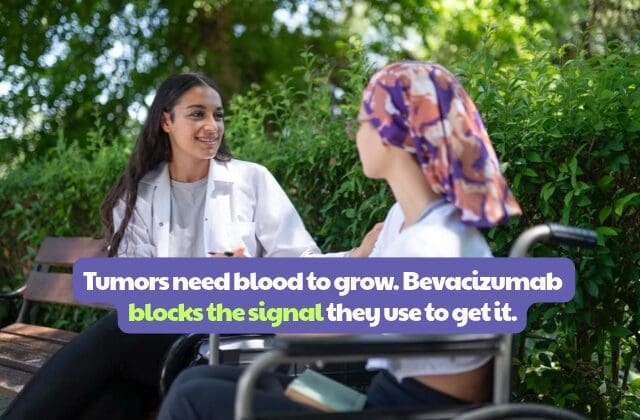
Tumors need blood. To grow past a certain size, a tumor has to build its own network of blood vessels, a process called angiogenesis. Ovarian cancer cells drive this process by releasing a protein called VEGF (vascular endothelial growth factor), which signals nearby blood vessels to sprout new branches toward the tumor.
Bevacizumab is a lab-made antibody that binds to VEGF and neutralizes it before it can reach its target. Think of it as intercepting the tumor’s supply order.
Two things happen as a result. The tumor’s new blood vessels stop forming and some existing ones regress. Any abnormal vessels that remain become more normal in structure, which lowers the fluid pressure inside the tumor. That second effect matters, because lower pressure means chemotherapy drugs can actually penetrate the tumor instead of being pushed back out.
This is why bevacizumab is typically started alongside chemotherapy rather than by itself. It acts as a partner drug that can help chemotherapy for ovarian cancer work better. Once chemo ends, though, many patients continue bevacizumab on its own as maintenance therapy to help keep the cancer from progressing.
When Bevacizumab and Ovarian Cancer Treatment Intersect
 Bevacizumab shows up at three different points in the ovarian cancer journey. The setting matters, because the evidence looks different in each one.
Newly Diagnosed Advanced Disease
The FDA approved bevacizumab in 2018 for people with stage III or IV epithelial ovarian, fallopian tube, or primary peritoneal cancer, given with carboplatin and paclitaxel and then continued on its own after chemotherapy ends.
The approval was based on the GOG-0218 trial, which enrolled 1,873 women after debulking surgery for ovarian cancer.
The trial compared three approaches. Women who received bevacizumab alongside chemotherapy and then continued it as maintenance went a median of 14.1 months before their cancer progressed, compared with 10.3 months for chemotherapy alone.
But women who received bevacizumab only during chemotherapy, with no maintenance afterward, reached a median of 11.2 months, which was not significantly better than chemotherapy alone.
In other words, the benefit came from continuing the drug as maintenance, not just adding it to chemo. Overall survival, though, was not significantly different between the groups.
A second large trial, ICON7, tested a lower dose in 1,528 women and found a smaller progression benefit. But it also found something important in a subgroup: among women at highest risk of the cancer coming back (stage IV disease, or stage III with more than 1 cm of tumor left after surgery), median overall survival was 39.3 months with bevacizumab versus 34.5 months without it.
That finding is why many oncologists reserve first-line bevacizumab for patients whose ovarian cancer staging and surgical results put them in a higher-risk category.
Platinum-Sensitive Recurrence
If your cancer returns more than six months after finishing platinum chemotherapy, it’s called platinum-sensitive.
The OCEANS trial enrolled 484 women in this situation. Adding bevacizumab to carboplatin and gemcitabine (two chemotherapy drugs), then continuing it on its own as maintenance until the cancer progressed, extended median progression-free survival from 8.4 months to 12.4 months.
The response rate also climbed from 57.4% to 78.5%. For anyone facing a recurrence, that means more time before needing the next line of treatment.
Platinum-Resistant Recurrence
When cancer returns within six months of platinum chemo, options narrow fast. The AURELIA trial randomized 361 women with platinum-resistant disease to chemotherapy alone or chemotherapy plus bevacizumab. Median progression-free survival nearly doubled, from 3.4 months to 6.7 months, and the response rate went from 12.6% to 30.9%.
Overall survival didn’t reach statistical significance. The same study found that bevacizumab improved abdominal and gastrointestinal symptoms more than chemotherapy alone.
What the data does suggest is that patients with more aggressive or higher-risk disease appear to benefit most. This is a conversation worth having directly with your gynecologic oncologist.
Bevacizumab plus PARP inhibitors
The picture changed with the PAOLA-1 trial, which tested adding the PARP inhibitor olaparib to bevacizumab maintenance in women with newly diagnosed advanced disease.
Median progression-free survival rose from 16.6 months to 22.1 months overall. The bigger story was in women with HRD-positive tumors, meaning tumors that struggle to repair their own DNA (this includes BRCA mutations).
In that group, the five-year survival rate was 65.5% with the combination versus 48.4% with bevacizumab alone.
That’s a genuinely meaningful difference, and it’s why BRCA testing for ovarian cancer and broader tumor testing should happen before maintenance decisions get made, not after.
Bevacizumab Side Effects to Watch For
 Bevacizumab is generally better tolerated than chemotherapy. It doesn’t cause hair loss or the same degree of nausea. But it has its own distinct set of side effects, and they are worth understanding before your first infusion.
The most common bevacizumab side effects:
- High blood pressure. This is the big one. In ICON7, grade 2 or higher hypertension occurred in 18% of the bevacizumab group versus 2% with chemotherapy alone. It’s usually manageable with blood pressure medication, but your BP will be checked before every infusion.
- Protein in the urine (proteinuria). VEGF also helps maintain the tiny blood vessels in the kidneys’ filtering units, called glomeruli. When bevacizumab blocks VEGF, those filters can become damaged and start letting protein leak into the urine. Expect a urine test regularly so your care team can catch changes early.
- Nosebleeds and minor mucous membrane bleeding.
- Fatigue, headache, and back pain.
Less common but serious side effects of bevacizumab:
- Gastrointestinal perforation, a hole in the stomach or intestine. It’s rare, occurring in roughly 1% to 2% of patients, but potentially life-threatening. Most cases happen within the first 50 days after the first dose, and nearly all occur during the chemotherapy phase rather than during maintenance. Risk is higher with a history of bowel obstruction, prior radiation, or extensive abdominal surgery.
- Blood clots and cardiovascular events.
- Poor wound healing. Bevacizumab is typically held for at least 28 days before and after surgery.
- Serious bleeding.
Report abdominal pain, persistent vomiting, fever, or constipation to your care team right away rather than waiting for your next appointment. These can be early signs of perforation. For a broader look at what treatment does to the body, see our guide to ovarian cancer treatment side effects.
Bevacizumab is not appropriate for people with active bleeding or clotting disorders.
How Long Does Treatment Last?
The standard is up to 15 months total, counting the cycles given alongside chemotherapy plus the maintenance period afterward. In GOG-0218, that worked out to roughly 22 cycles of bevacizumab given every three weeks. ICON7 used a shorter course, continuing bevacizumab for 12 additional cycles after chemotherapy ended.
Because the trials differed, “up to 15 months” is the more accurate way to describe the standard, and your oncologist may tailor the length to your situation.
Researchers tested whether doubling that would help. A European phase III trial randomized 927 women to either 15 or 30 months of maintenance bevacizumab. Longer treatment improved neither progression-free nor overall survival, and grade 3 to 5 adverse events were somewhat higher in the 30-month group. So: more is not better here. Fifteen months remains the standard of care.
What about LGSOC and Borderline Tumors?
Almost every major bevacizumab trial enrolled patients with high-grade serous and other common epithelial subtypes. Low-grade serous ovarian cancer and borderline ovarian tumors were rarely studied on their own. So the headline numbers above may not translate directly to these rarer diagnoses.
That said, the smaller evidence base is encouraging. One retrospective study of LGSOC patients found an overall median response rate of 47.5% with bevacizumab, higher than what’s typically seen with conventional chemotherapy in this chemo-resistant subtype.
In another analysis, LGSOC patients who received bevacizumab with first-line chemotherapy had a median progression-free survival of 47.9 months compared with 22.6 months for chemotherapy alone.
Those are retrospective studies, not randomized trials. The authors explicitly called for a prospective clinical trial to confirm the findings.
Bevacizumab: Questions to Ask Your Oncologist
Bring these to your next appointment:
- Based on my stage and how much disease was left after surgery, do I fall into the higher-risk group where bevacizumab showed a survival benefit?
- Has my tumor been tested for BRCA and HRD status, and would that change whether I add a PARP inhibitor?
- Given my surgical history, what’s my personal risk of bowel perforation?
- What’s the plan for monitoring my blood pressure and kidney function?
- Is a biosimilar (an approved lower-cost version of the same drug) available, and how would that affect my out-of-pocket cost?
That last one matters. Cost is a real barrier to bevacizumab access, and biosimilar versions can bring the price down substantially. Our guide to ovarian cancer treatment cost covers assistance programs worth exploring. If you’re facing a recurrence, our list of questions to ask about recurrent ovarian cancer goes deeper.
What Bevacizumab Can and Can’t Do
Bevacizumab is an established, well-studied option that reliably buys time before progression, works across first-line and recurrent settings, and pairs powerfully with PARP inhibitors in HRD-positive disease. It is not a cure, and its effect on overall survival is real but narrower than anyone would like.
For women with LGSOC and borderline tumors, the evidence is thinner than it should be. Not because the drug doesn’t work, but because nobody has yet funded the research.
None of that means bevacizumab is wrong for you. It means the decision deserves a real conversation, one that accounts for your stage, your surgical results, your tumor testing, and your own tolerance for the side effects that come with it.
Bring the questions above to your gynecologic oncologist and ask them plainly. The more specific you get about your own situation, the more useful the answer will be.