
Having Children After Ovarian Cancer: Your Family-Building Options After Fertility Loss
August 25, 2026

An ovarian cancer diagnosis is hard enough on its own. But for many women, it arrives with a second loss folded inside it: the ability to carry a child.
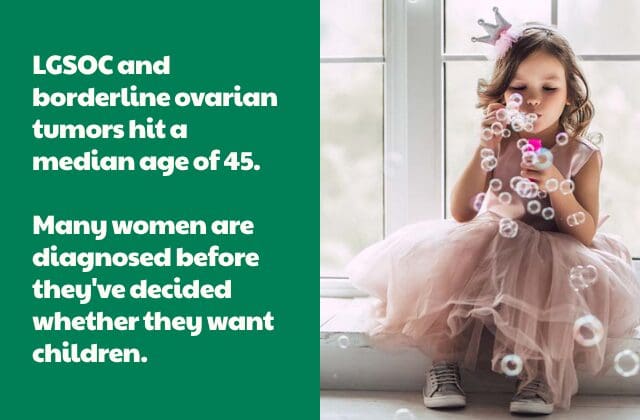
This hits our community especially hard. Low-grade serous ovarian cancer (LGSOC) and borderline ovarian tumors (BOTs) primarily affect younger women, with a median age of 45. Many are diagnosed before they’ve started a family, or before they’ve even decided whether they want one.
Here’s what we want you to know upfront: having children after ovarian cancer is still possible for many survivors. Pregnancy is one path to parenthood, but it’s not the only one. This guide walks through your options, from preserved eggs to surrogacy to adoption, and takes an honest look at the grief that often comes first.
How Ovarian Cancer Treatment Affects Fertility
Ovarian cancer treatment can affect fertility in several ways, and understanding what happened to your body is the first step toward understanding what’s possible next.
Surgery. Oophorectomy surgery removes one or both ovaries. When both ovaries are removed, your body no longer produces eggs. An ovarian cancer hysterectomy removes the uterus, which means carrying a pregnancy is no longer possible, even if you have frozen eggs or embryos.
Chemotherapy. Certain chemotherapy drugs for ovarian cancer, particularly alkylating agents like cisplatin and cyclophosphamide, can damage eggs or cause the ovaries to stop releasing them, a condition called primary ovarian insufficiency. For some women this is temporary. For others, it’s permanent and brings on chemo-induced menopause or early menopause well before its natural time.
Age and treatment intensity matter. Your age at treatment, the drugs used, and the doses all influence whether fertility loss is partial or complete. No two situations look exactly alike, which is why a consultation with a reproductive endocrinologist (REI) matters so much.
On timing: the ideal moment to see an REI is before surgery or chemotherapy begins, while preservation options are still on the table. If you’re reading this pre-treatment, ask for that referral now, even if it means asking twice. It often takes only a short delay to freeze eggs or embryos, and many oncologists can build that window into your plan.
For a lot of women, though, that window never existed. Ovarian cancer is often found during surgery for something else entirely, a suspected cyst, a mass, an emergency. You wake up already diagnosed and already treated, with no chance to weigh anything beforehand. If that was your experience, nothing was missed on your part. There was simply nothing to decide.
If treatment has already happened, an REI visit is still worth it. Just know that ovarian function can take time to bounce back, so fertility testing is generally more informative around a year out.
Coping With Fertility Loss
 Before we talk logistics, let’s talk about the part that doesn’t fit neatly into a treatment plan.
Losing your fertility is a genuine loss, and grieving it is normal. That’s true even if you weren’t sure you wanted children. What you lost wasn’t just a medical function. It was a version of your future, and the chance to decide for yourself.
People coping with cancer-related infertility commonly experience grief, anger, guilt, and a shaken sense of identity. Some women accept the news early, reasoning that survival came first. Others cope fine during treatment, then struggle once it ends and the quiet sets in. There is no right way.
The grief can also resurface without warning. A friend’s pregnancy announcement. A baby shower invitation. A casual “so when are you having kids?” from someone who doesn’t know. These moments sting, and it’s okay to protect yourself from them. Most friends will understand if you skip the shower and send a gift instead.
A few things that genuinely help:
- Let yourself feel it. There are no right or wrong emotions here, only the need to process them, whether through journaling, movement, or talking it out.
- Skip the blame. There’s no reason this happened, and self-blame burns energy you need for healing.
- Talk to a professional. A therapist or counselor who understands cancer-related infertility can make a real difference. Ask your care team for a referral.
- Find your people. Ovarian cancer support groups connect you with women who understand this specific loss without needing an explanation. AYA (adolescent and young adult) groups serve people diagnosed between 15 and 39, where fertility, dating, and career disruption come up constantly instead of never. There are also groups built entirely around cancer and fertility, where nobody has to preface the conversation. Your care team or a social worker at your cancer center can point you toward both.
- Bring your partner in. If you have one, grieve as a team. Your feelings will shift day to day, and so will theirs. Keep talking anyway.
Infertility is invisible, and that invisibility can breed isolation. You are not alone in this, and you don’t have to navigate it alone either.
Your Options for Having Children After Ovarian Cancer
Once you’re ready to look forward, here are the main paths to parenthood after ovarian cancer treatment:
- Using your preserved eggs or embryos, through IVF or a surrogate
- Gestational surrogacy, with your own or donor eggs
- Egg and embryo donation, if preservation wasn’t possible
- Adoption and fostering
If You Preserved Eggs or Embryos Before Treatment
If you froze eggs or embryos before treatment began, you have a direct path to a biological child.
Frozen eggs can be thawed, fertilized with a partner’s or donor’s sperm, and transferred as embryos. If your uterus is intact, that transfer can happen in your own body through IVF. If your uterus was removed, those same embryos can be carried by a gestational surrogate.
We cover the freezing process itself, including timing, success rates, and costs, in our guide to oocyte cryopreservation.
One important note on timing after treatment: you’ll often hear two years cited as the standard wait before trying to conceive, since that clears the window of highest recurrence risk and gives your body time to recover.
But the real answer is more individualized than that. Published guidance ranges anywhere from six months to two years, depending on your subtype, your stage, the treatment you had, and how you’re doing now.
This is a decision that usually involves more than one specialist. Your gynecologic oncologist, a reproductive endocrinologist, and sometimes a maternal-fetal medicine doctor all weigh in on what’s safe and when. Ask each of them directly. A number that’s right for someone else with a different diagnosis isn’t your number.
Surrogacy After Ovarian Cancer
 For women who can no longer carry a pregnancy, gestational surrogacy makes a biological or partially biological child possible.
Here’s how it works: an embryo, created from your frozen eggs, donor eggs, or a donated embryo, is transferred to a surrogate’s uterus. The surrogate carries the pregnancy but has no genetic connection to the baby.
Three honest realities to plan for:
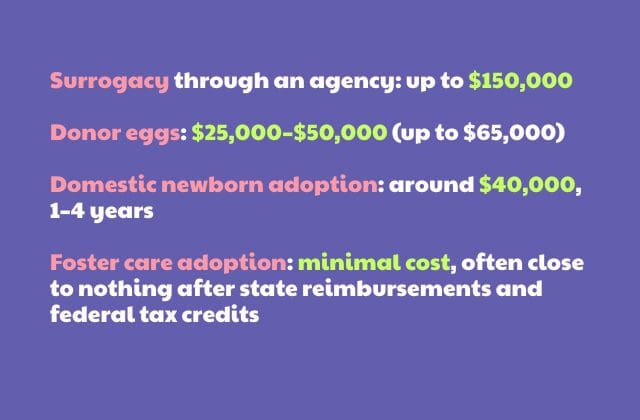
Cost. Surrogacy through an agency can run up to $150,000. Some families reduce costs by working with a known carrier, such as a relative or close friend.
If you go that route, don’t skip the formal steps just because you trust the person. Your carrier still needs full medical clearance, and both of you need your own independent legal counsel, not one shared attorney. Those protections exist for situations where something unexpected happens, and they matter most among people who never imagined needing them.
Legal complexity. Surrogacy laws vary dramatically by state. Talk to a reproductive lawyer before you start, not after.
Medical risk to your carrier. Gestational surrogacy pregnancies are classified as higher risk than spontaneous pregnancies. Research has found elevated rates of hypertensive disorders of pregnancy, including preeclampsia, in gestational carriers compared to people who conceived on their own.
This is worth naming out loud early, especially with a known carrier. Your friend or sister is agreeing to a pregnancy that will be monitored more closely than her own were. Make sure she hears that from a maternal-fetal medicine specialist, not just from you.
It’s a long road, emotionally and financially. But for many survivors, it’s the road that leads to holding their child.
Egg and Embryo Donation
Not everyone gets the chance to preserve fertility before treatment. Diagnosis through emergency surgery, or treatment that couldn’t wait, takes that option off the table for many women. That doesn’t close the door on parenthood.
Donor eggs are fertilized with your partner’s or a donor’s sperm. If your uterus is intact, you can carry the pregnancy yourself, experiencing pregnancy and childbirth. If not, the embryos go to a surrogate. Donor eggs range from $25,000 to $50,000 and can even cost up to $65,000.
Donor embryos come from families who completed their own fertility treatment and chose to donate their remaining embryos. This option typically costs less than donor eggs and may involve shorter wait times.
The genetic connection question is deeply personal, and there’s no right answer. Some women grieve it. Others find it matters far less than they expected once they’re holding their baby.
Adoption After Cancer
Adoption is how many survivors build their families, and a cancer history does not disqualify you.
But it’s worth going in with clear eyes: young survivors often face extra scrutiny in the process. Agencies and home study evaluators weigh health and life expectancy, and a recent diagnosis can prompt more questions, more documentation, and sometimes longer timelines than other applicants face.
That’s frustrating, and it’s also navigable. Knowing it’s coming is half the work.
That said, agencies do have requirements worth knowing about ahead of time:
- Most will ask for a doctor’s letter confirming your health status. Some want specifics: documentation of five years disease-free, or a statement from your oncologist that your predicted lifespan is normal. Answer health questions truthfully, and ask your oncologist for a detailed letter rather than a brief form. It carries far more weight.
- Some agencies require a certain amount of time to have passed since treatment ended.
- Domestic newborn adoption in the U.S. costs around $40,000 and takes one to four years. International policies vary by country, and some nations have their own restrictions around applicants with a cancer history.
- Adopting through foster care is a different picture entirely. Costs are minimal, often close to nothing once state reimbursements and federal tax credits are factored in. And the need is real: more than 100,000 children in the U.S. foster system are waiting for adoptive families right now, many of them school-age or part of sibling groups. If your vision of parenthood isn’t tied to a newborn, this path is faster, cheaper, and desperately short on families.
Choosing a Childfree Life Is Valid, Too
Some women work through all of this and land somewhere different: not pursuing children at all.
Maybe the costs feel out of reach. Maybe the emotional toll of more medical processes, after everything cancer already took, is too much. Or maybe, given space to sit with it, a childfree life simply feels right.
That decision deserves respect, not justification. A full, joyful, meaningful life doesn’t require children, and choosing peace over more uncertainty is not giving up. It’s a choice, and it’s yours.
Questions to Ask Your Care Team
Whether you’re pre-treatment or years past it, these conversations matter:
- Can I get a referral to a reproductive endocrinologist or fertility specialist?
- Based on my treatment, what does my fertility realistically look like now?
- How long should I wait before pursuing pregnancy or surrogacy?
- Was fertility sparing surgery in ovarian cancer an option in my case, or is it for a future recurrence?
- What should I know about hormones, genetic disposition, pregnancy, and my specific subtype?
That last question matters more than most patients realize. Borderline tumors, for instance, often allow for more conservative treatment, and we cover what that means for family planning in our guide to borderline ovarian tumors and fertility.
Moving Forward on Your Own Terms
Fertility loss is one of the heaviest prices young women pay for ovarian cancer treatment. Nothing in this article undoes that, and you shouldn’t have to pretend otherwise.
But the path to parenthood is wider than most people realize when they first hear the news. Frozen eggs. A surrogate. A donor. An adoption agency that has worked with survivors before. Some women follow one of these routes and become mothers. Others sit with all of it, weigh the costs and the toll, and build a different kind of full life. Both are real outcomes, and both belong to you.
If you’re reading this before treatment starts, or supporting someone who is, our guide to ovarian cancer and pregnancy covers fertility preservation options while there’s still time to act on them.
Better treatments mean less invasive surgeries. Earlier detection means more women get to keep the choice. That research is happening right now, and it’s funded by people who decided this shouldn’t keep happening to young women.