
No Evidence of Disease: What NED Really Means After Ovarian Cancer
September 22, 2026

Hearing “no evidence of disease” after months of ovarian cancer treatment should feel like crossing a finish line, and for some women it does. For plenty of others, it lands in a stranger place. Relief, then a question nobody quite answers: does this mean I’m done?
Let’s get specific.
No Evidence of Disease Definition: In Plain Language
The “no evidence of disease” (NED) definition is narrower than most people assume. NED means that at this moment, using the tests currently available, doctors cannot find cancer in your body.
That’s it. That’s the whole claim. It’s a statement about detection, not about biology. Imaging has a floor. A CT scan generally can’t detect disease below a few millimeters. Blood tests measure proteins, not tumors. So NED describes the limits of the equipment as much as it describes you.
Your care team is telling you something true and something good. They are not telling you that every cancer cell is gone, because no test available today can confirm that.
Sign up to receive vital updates through email, and learn how you can get involved. "*" indicates required fieldsStay informed
No Evidence of Disease in Ovarian Cancer: What the Tests Show
No evidence of disease in ovarian cancer usually rests on three things reviewed together.
- Physical and pelvic exam. Your gynecologic oncologist checks for masses, fluid, and changes you might not have noticed.
- CA-125 blood test. A protein that rises in many, though not all, ovarian cancers. Its limits as a standalone tool are real, which is why we covered them in our guide to CA125 ovarian cancer screening.
- Imaging. Typically CT of the chest, abdomen, and pelvis. Some patients also get an ovarian cancer ultrasound as part of follow-up, particularly after fertility-sparing surgery.
Radiologists and oncologists often measure response using the RECIST criteria, a standardized system for describing whether lesions shrank, grew, or disappeared on a scan. When nothing measurable remains, you may see “complete response” in the report. Your oncologist may then say NED out loud.
Is No Evidence of Disease the Same as Remission?
Mostly, yes. “Is no evidence of disease the same as remission” is one of the most searched questions on this topic, and the honest answer is that most oncologists use the two interchangeably. Complete remission and NED both mean nothing detectable.
No Evidence of Disease vs Remission: Where the Terms Differ
The no evidence of disease vs. remission distinction shows up in three practical ways.
Remission comes in degrees. NED doesn’t. Partial remission means the tumor shrank substantially but is still visible. There’s no such thing as partial NED. You either have detectable disease or you don’t.
Remission implies a prior response to treatment. Remission and response describe change, so they need a starting point to measure from. If surgery removed all visible tumor, or if your disease was never measurable on a scan to begin with, there’s nothing to compare against and response is undefined. NED is the term that fits that situation.
Some clinicians deliberately avoid “remission.” They worry it sounds too much like an ending. NED, with its clinical neutrality, keeps the door open to what comes next.
Ask your own oncologist which term they use and what they mean by it. A tumor board reviewing your case may phrase it differently again.
NED is Not the Same as Cured
 This is the distinction that matters most, and it’s where “cancer-free” causes trouble.
“Cancer-free” implies something no test can verify: that zero cancer cells remain anywhere in your body. Most oncologists won’t make that claim. Some will say it after five clear years, when surveillance shifts toward survivorship; many still won’t.
The numbers explain the caution. According to research, for women who reach clinical remission after initial treatment for epithelial ovarian cancer, roughly 75% with advanced-stage disease will eventually experience recurrence. That figure isn’t meant to frighten you. It explains why your care team keeps scheduling appointments after delivering good news.
NED is a real milestone. It is also a status that requires monitoring.
Do Doctors Use “NED” for LGSOC and Borderline Tumors?
Sometimes they do, but not always, and not in quite the same way. This trips up a lot of patients.
The whole vocabulary of remission grew up around cancers that respond dramatically to chemotherapy, and high-grade serous ovarian cancer fits that mold. You have surgery, you go through platinum chemo, the tumor shrinks, your CA-125 falls, and someone says complete remission.
Low-grade serous ovarian cancer often doesn’t cooperate, because it tends to be relatively chemoresistant. In a widely cited review of a study of 58 women treated for recurrent LGSOC across 108 separate chemotherapy regimens, the overall response rate was just 3.7%, while stable disease was the outcome in about 60% of those regimens.
Stable disease means the tumor is still visible but isn’t growing. In LGSOC, that counts as a genuinely good result, and it is not the same thing as NED.
Plenty of women with low-grade disease live for years with measurable tumor on their scans that simply sits there. Their oncologist talks about disease control or progression-free survival rather than remission.
If you’re stable on an aromatase inhibitors with visible disease, you haven’t failed to reach some benchmark. You’re in a different category, and it’s a valid one. We go deeper into that in chronic management of LGSOC and in our overview of LGSOC drugs.
Borderline ovarian tumors sit somewhere else again. BOTs are not invasive carcinomas, and most patients are treated with surgery alone. The language follows the treatment, so you’re more likely to hear that the tumor was removed with clear margins, or that you’re disease-free, than that you’re in remission.
Researchers tracking these patients use the term recurrence-free survival instead.
“Complete remission”, “stable disease”, and “disease-free after surgery” describe three genuinely different situations. The term you hear depends on your subtype and how it’s treated, not on how well you’re doing.
Why LGSOC and BOT can Mean Monitoring for Life
Here’s where the standard advice fails the women we write for most often.
Conventional wisdom says most cancers that return do so within five years, so clear scans at year five mean you’re likely not to recur. That logic holds up reasonably well for fast-growing disease, but it holds up poorly for the slow ones.
Consider what the long-term data shows for borderline tumors. Overall ten-year survival for stage I BOT sits somewhere around 70% to 95%. Staying disease-free over that same stretch is a separate question, and the answer depends less on your stage than on how much tissue was removed.
One older study found ten-year disease-free survival of 89.1% after radical surgery versus 57.4% after conservative surgery. The authors reported no significant difference in disease-free survival across stages. What predicted recurrence was the extent of the operation, not how advanced the tumor looked on paper.
Two caveats: surgical technique has moved on considerably in the twenty years since, so today’s fertility-sparing surgery isn’t the same procedure that study was measuring. And recurring after conservative surgery is not the same as dying of the disease. Many of those recurrences are treated with a second operation.
The reason this matters for surveillance is timing. Recurrence after conservative management can show up years out, well past the point most women assume they’re in the clear.
As for LGSOC, published estimates put recurrence at roughly half of patients after primary surgery, but most of those relapses land inside the window you’d expect.
One series reported an average time to recurrence of 32 months. In another cohort, just one patient out of 49 recurred more than five years after treatment.
So late relapse is possible, and worth knowing about, but it isn’t the typical course. The more common scenario is recurrence in years two through four, which is exactly when surveillance is at its most frequent. What that really argues for is not panicking at year six, but taking years one through five seriously. More on what that looks like in our guide to LGSOC recurrence.
A Rising CA-125 while You’re NED Doesn’t Automatically Restart Treatment
 This one surprises people, so it’s worth explaining carefully.
CA-125 often climbs before any symptom or scan finding appears. The instinct is obvious: catch it early, treat it early, buy time. Researchers tested exactly that.
The MRC OV05/EORTC 55955 trial registered 1,442 women who were in complete remission after first-line platinum chemotherapy with a normal CA-125, then monitored their levels. Of those, 529 went on to show a confirmed CA-125 rise and were randomly assigned to start chemotherapy right away or to wait until clinical signs of relapse appeared. That randomized group of 529 is where the survival comparison comes from.
Women in the early-treatment arm began chemo a median of 4.8 months sooner. Overall survival showed no difference between the two arms.
What that means for you is that a single elevated CA-125 is information, not a verdict. Your oncologist may confirm it with a repeat draw, order imaging, or recommend watchful waiting, and all of those can be reasonable.
If the recommendation doesn’t sit right, an ovarian cancer second opinion is always your right.
What Surveillance Looks Like Once You Reach NED
Follow-up schedules vary by subtype, stage, and provider, but the general shape is consistent.
Different bodies publish different schedules, so the specifics depend on whose guideline your center follows. NCCN recommends visits every two to four months for the first two years, every three to six months for the next three years, then annually after year five. Other organizations set the intervals slightly wider or narrower. The shape is the same everywhere: frequent early, tapering as time passes, with imaging ordered at the clinician’s discretion rather than on a fixed calendar.
Some patients on maintenance therapy stay on treatment while NED. PARP inhibitors and aromatase inhibitors are both used this way, depending on tumor biology. Being NED and being on medication are not contradictory.
The Emotional Aspect of NED
NED is emotionally complicated, and that’s not a personal failing.
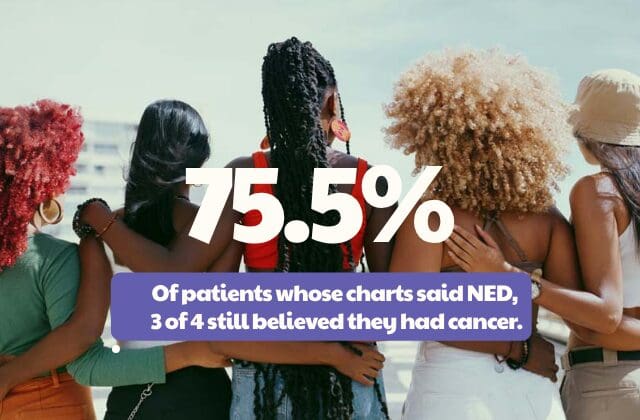
One study looked at how well patients’ understanding matched their physicians’ charts. Among participants whose doctors had recorded NED, 75.5% still reported that they currently had cancer, and anxiety ran at 30% in that group versus 12% among patients whose understanding matched their physician’s, and depression at 27% versus 7%.
That’s three out of four cancer patients carrying a diagnosis their chart says they no longer have.
Some of that gap comes down to communication. Some of it reflects the genuine uncertainty baked into the term, and for LGSOC and borderline patients, the added weight of knowing surveillance may not have an end date.
Either way, if you’re NED and still bracing for bad news before every scan, you are in the majority. We wrote about that specific dread in scanxiety, and about the wider emotional load in our article on ovarian cancer and mental health.
Questions Worth Asking at Your Next Appointment
Bring these with you, and write the answers down.
- When you say NED, do you mean the same thing as complete remission?
- Which tests are you basing that on, and what are their blind spots for my subtype?
- What’s my personal recurrence risk, given my stage and histology?
- Will we monitor CA-125 routinely, and what would a rise actually change?
- What symptoms should send me to you between scheduled visits?
- Does my follow-up plan change after five years, and who follows me after that?
Take the Good News and Keep the Appointments
NED is a probabilistic statement because our tools are imperfect. Until then, take the good news for what it is. Then keep the appointments, learn your own risk pattern, and stay with a specialist who understands your subtype, especially if that subtype is one that takes its time.