
Telehealth for Ovarian Cancer: What It Covers and How to Prepare
September 28, 2026
Telehealth for ovarian cancer has grown into one of the most practical tools patients have, and yet most people are never told it’s an option until they ask.
That’s a problem worth fixing. Because when you’re managing appointments, scans, bloodwork, and side effects all at once, the difference between a two-hour drive and a twenty-minute video call is not a small convenience.
Here’s what telehealth for cancer care actually involves, where it helps, where it falls short, and how to walk into your first virtual appointment prepared.
What Telehealth for Ovarian Cancer Means
Telehealth is care delivered remotely. Video visits, phone calls, secure messages through a patient portal, shared lab results, and remote monitoring of things like blood pressure all fall under the umbrella. You may also hear it called telemedicine, virtual care, or remote consultation.
 For ovarian cancer specifically, telehealth fills the gaps between the appointments that genuinely require hands-on care. Surgery, chemotherapy infusions, and imaging happen in person, and they always will.
But a large share of ovarian cancer care is conversation: reviewing scan results, deciding whether a new symptom warrants a change in treatment, adjusting a dose, or talking through what happens next. None of that requires you to be in the building. If neuropathy worsens three weeks into a chemotherapy cycle, a video visit can get you an answer in a few days instead of at your next scheduled appointment.
Most cancer centers now use what’s called a hybrid model: some visits in person, some virtual, chosen based on what the appointment actually requires. This is becoming a standard approach for oncology: telehealth was never meant to replace your care team. It’s meant to extend it.
The Benefits of Telehealth for Ovarian Cancer Patients
The benefits of telehealth for ovarian cancer go well beyond skipping a drive, though that alone matters more than most people expect. Three of them show up consistently in the research.
It closes a geographic gap that shouldn’t exist
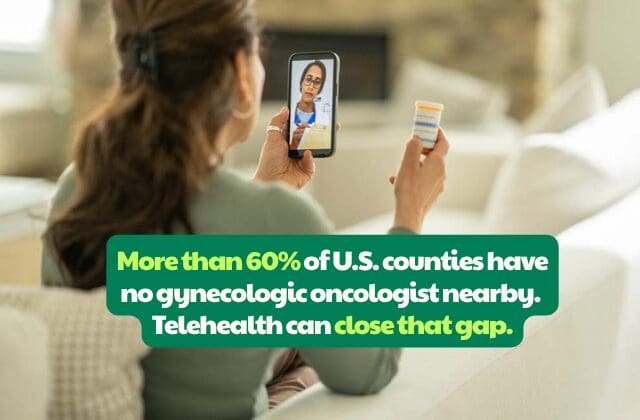
More than 60% of U.S. counties have no gynecologic oncologist in the county or in any adjacent county, according to research. That statistic matters more than almost anything else on this page, because seeing a gynecologic oncologist rather than a general surgeon or general oncologist is associated with better outcomes in ovarian cancer.
Telehealth means you can get your imaging and labs done locally, then review them with a specialist who may be several states away.
One rural program in south Louisiana shows how well this can work. In one research study, patients see a nearby gynecologist in person while their gynecologic oncologist joins by video on a clinic tablet. Across 63 patients and 178 appointments, the median drive was 16.9 miles instead of the 137 miles the same visit would have required, and 76.9% of appointments still met NCCN guidelines.
It Makes Side Effect Management Faster
Ovarian cancer treatment side effects don’t schedule themselves around your next appointment. Virtual visits let you flag a new symptom in days instead of weeks, which sometimes means a dose adjustment instead of a hospital stay.
There’s evidence behind this. Researchers tested a six-session telehealth program called REVITALIZE for women on PARP inhibitors who were struggling with fatigue, a side effect that affects nearly half of patients on these drugs.
At 12 weeks, participants reported significantly less fatigue interference in daily life compared to usual care, with a large effect size. Participants also had numerically fewer dose reductions and delays.
Staying on your treatment is the point. Fatigue that goes unmanaged is one of the reasons people can’t.
It Protects the Emotional Side of Survivorship
Follow-up appointments are often built around one question: has the cancer come back? This is an important question, but it might also leave a lot unaddressed, including anxiety, sexual health, scanxiety, and the fear that shows up in the quiet weeks between scans.
A phase 2 randomized trial tested structured nurse-led telehealth follow-up using a patient-reported symptom questionnaire, and found the model feasible with high patient and nurse satisfaction. The trial was small and underpowered, so treat the emotional well-being findings as early and promising rather than settled.
Still, the direction is encouraging: when someone systematically asks about your symptoms, more of them get addressed.
What Telehealth for Cancer Can’t Do
Being direct about this matters more than selling the technology.
Some things require you in the room. Surgery, obviously. Chemotherapy infusion and radiation. Diagnostic bloodwork and biopsies. Pelvic exams, which remain part of NCCN surveillance recommendations and cannot be done over video.
Many oncologists also prefer to deliver a new diagnosis or a recurrence face to face, and many patients prefer that too. Patients consistently describe how much harder it is to absorb difficult news over the phone, when you can’t read the clinician’s face or have someone reach over and take your hand.
Your first appointment with a new specialist is often better in person as well, simply because it’s where the relationship starts.
Telehealth Options Worth Asking About
 Telehealth for ovarian cancer extends well past the oncologist’s calendar. Depending on your center, you may be able to use virtual visits for:
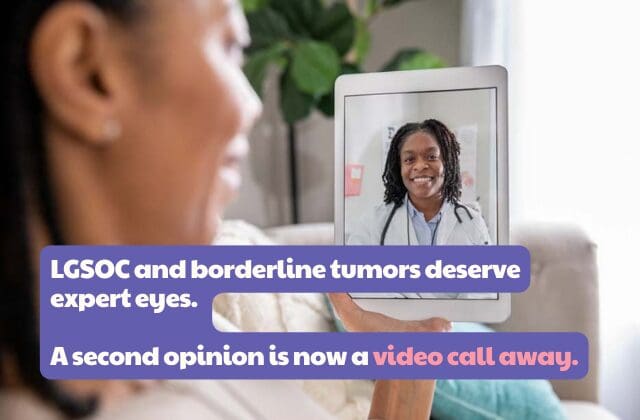
- Second opinions. Getting an ovarian cancer second opinion from a major center no longer requires a flight, which matters enormously for rare subtypes like LGSOC and borderline tumors.
- Genetic counseling. Both pre-test counseling and results discussions for BRCA testing for ovarian cancer and genetic testing for LGSOC are routinely handled remotely.
- Nutrition counseling. Especially useful during treatment, when your ovarian cancer diet needs to shift week to week.
- Mental health support. Therapy, psychiatry, and stress management for cancer patients.
- Treatment teaching and medication management. Oral chemotherapy tutorials, refills, and dose questions.
- Survivorship and surveillance check-ins, including conversations about ovarian cancer recurrence.
- Clinical trial screening. Some trial visits can now be done remotely, which lowers the barrier for patients far from academic centers.
One thing telehealth is not built for: emergencies. If you’re dealing with severe abdominal pain, a fever, uncontrolled vomiting, or trouble breathing, know the signs that call for emergency care for ovarian cancer and act on them.
How to Prepare for a Telehealth Appointment
A virtual visit rewards preparation more than an in-person one does. There’s no waiting room to collect your thoughts in, and no nurse to prompt you. Run through this before you log on.
A week ahead
- Confirm the platform and whether you need to download anything
- Sign up for your center’s patient portal if you haven’t
- Schedule any bloodwork at least 24 to 48 hours ahead so results are ready to discuss
The day before
- Write down your symptoms: when they started, what makes them worse, how they’ve changed
- Gather your medication bottles, not just a list, so you can read exact doses aloud
- Write your questions in priority order. Our guide to ovarian cancer questions is a good starting point
- Charge your device and test your camera, microphone, and connection
- Ask someone to join you as a second set of ears and a notetaker
Ten minutes before
- Find a quiet, private, well-lit room
- Sit facing a light source so your clinician can see your face
- Have water, your notebook, and your medications within reach
- Expect a delay, because clinics can run behind on video, too
Before you hang up
- Repeat back the plan in your own words
- Confirm who schedules the next appointment and whether it’s virtual or in person
- Ask what would prompt you to call before then
- Ask for a visit summary in the portal
That last one is underrated. A written summary you can reread later that day is worth more than anything you’ll remember from the call itself.
The Access Gap We Should Be Honest About
Telehealth can narrow disparities. It can also widen them.
In a national study of 6,460 patients with ovarian or endometrial cancer, fewer than 30% used telemedicine even once between March 2020 and October 2021. In community cancer practices, Black patients were significantly less likely to have a telemedicine visit than white patients, and uninsured patients were less likely than privately insured patients.
Broadband access, device access, and digital literacy are real barriers, not footnotes. In one survey group, a quarter of patients lacked reliable home internet and 45% could not drive themselves to appointments.
If technology is your barrier, say so out loud. Some centers loan tablets, provide in-clinic space with internet, or offer phone-only visits. Coverage rules for telehealth also change frequently, so ask your team or insurer what’s covered before you assume it isn’t. If cost is the sticking point, our guide to cancer treatment cost covers assistance programs worth knowing about.
Making Telehealth for Ovarian Cancer Work for You
Telehealth works best when you treat it as an addition to your care rather than a substitute for it. Ovarian cancer asks a great deal of the people living with it. Anything that gives back a little time, energy, or access to real expertise is worth using, and self-advocacy is what turns the tool into better care. When you need people who understand the parts that don’t fit into a 15-minute appointment, ovarian cancer support groups are there for exactly that.
This article is for informational purposes and is not a substitute for medical advice. Talk with your gynecologic oncologist about which of your appointments are appropriate for telehealth.