
Ovarian Cancer Maintenance Therapy: What It Is, Who It Helps, and What to Ask
September 16, 2026

Ovarian cancer maintenance therapy is the treatment you take after chemotherapy ends, and it exists for one reason: to keep the cancer from coming back for as long as possible.
For a lot of patients, this is the part of the journey nobody explains well. Surgery has a date on the calendar. Chemo has a schedule. Maintenance can last for months or years, often without a known endpoint, which makes it differ from active treatment.
So let’s break it down. Here’s what patients, caregivers, and families should actually know before that conversation happens.
What Is Maintenance Therapy for Ovarian Cancer?
Maintenance therapy is a medication you continue taking after your initial treatment is finished, usually debulking surgery for ovarian cancer followed by platinum-based chemotherapy for ovarian cancer.
It is not more chemo. Most maintenance drugs are pills you take at home every day. Some can be an infusion given every few weeks. You keep taking it for a set period, often up to two or three years, or until it stops working or the side effects become too much.
Doctors typically offer it to patients whose cancer responded to chemotherapy, meaning the disease shrank significantly or disappeared on scans. Your care team may describe this using the RECIST criteria, the standard system for measuring treatment response.
Why Maintenance Therapy in Ovarian Cancer Became Standard
Here’s the hard truth that drove all of this research. Most women with advanced ovarian cancer respond well to first-line treatment, then relapse.
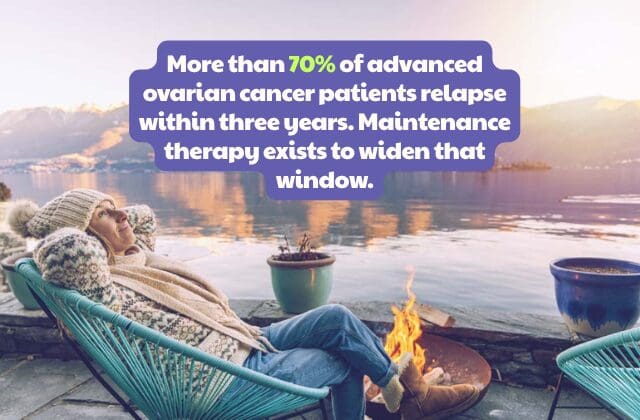
According to research, more than 70% of patients with advanced epithelial ovarian cancer relapse within three years of finishing first-line treatment.
That gap is exactly where maintenance therapy lives. Our article on ovarian cancer recurrence explains why delaying that first recurrence matters so much.
Maintenance Therapy for LGSOC and Borderline Ovarian Tumors
Low-grade serous ovarian cancer behaves differently than other ovarian cancers, specifically high grade serous ovarian cancer (HGSOC), and the maintenance conversation looks different, too.
LGSOC tumors tend to express hormone receptors at high levels, so hormonal maintenance is the more relevant approach. In one study, women who received hormonal maintenance therapy after surgery and chemotherapy had a median progression-free survival of 64.9 months, compared with 26.4 months for those who were simply observed. Most received letrozole, with others receiving tamoxifen or anastrozole.
Borderline ovarian tumors are a different story again. Standard borderline ovarian tumor treatment is surgical, and most patients don’t receive maintenance drug therapy at all.
So if you have LGSOC or a borderline tumor, the drugs described below may never enter your treatment plan. That’s not an oversight. It’s biology. The differences between LGSOC and HGSOC run deep enough to change which maintenance approach makes sense, and the same holds for other rare ovarian cancer subtypes.
The approved maintenance drugs below were studied primarily in high-grade serous disease, which accounts for the majority of advanced ovarian cancer cases. Here’s what they are and how they work.
The Main Types of Maintenance Therapy for Ovarian Cancer
 There are two drug classes approved for this, and sometimes they’re used together.
PARP inhibitors
A PARP inhibitor blocks an enzyme that cancer cells use to patch up their own damaged DNA. That matters most if you carry a BRCA mutation. BRCA1 and BRCA2 normally handle a different kind of DNA repair, so when that pathway is already broken and a PARP inhibitor shuts down the backup, the cancer cell runs out of ways to fix itself and dies. Healthy cells still have both repair systems intact, which is why the drug hits tumor cells harder.
This is where PARP inhibitors shine. Patients with BRCA mutations, whether inherited or found only in the tumor, consistently see the biggest gains from these drugs.
They’re not limited to BRCA-positive patients, though. Doctors also prescribe them for HRD-positive tumors and, in some situations, regardless of mutation status. The benefit just gets smaller as you move away from BRCA, which is why your BRCA testing results drive so much of this decision.
Three are used in ovarian cancer:
- Lynparza (olaparib)
- Zejula (niraparib)
- Rubraca (rucaparib)
All three are taken orally. Which one your doctor recommends depends on your mutation status, whether you received bevacizumab during chemo, and which line of treatment you’re in.
Bevacizumab (Avastin)
Bevacizumab works differently. Tumors need blood vessels to grow, and they send out a signal called VEGF to build them. Bevacizumab blocks that signal, which starves the tumor of oxygen and nutrients.
One important detail patients often miss: bevacizumab generally has to be part of your chemotherapy regimen from the start in order to continue as maintenance afterward. It isn’t usually added later. It’s given by IV infusion rather than as a pill.
For some patients, particularly those with HRD-positive tumors, doctors combine olaparib with bevacizumab. This combination came out of the PAOLA-1 trial and is now a standard option for certain patients under the NCCN guidelines for ovarian cancer.
Testing Comes First, Always
You cannot make a smart maintenance decision without knowing what’s driving your tumor. Two categories of testing matter here:
- Genetic (germline) testing looks at mutations you were born with and carry in every cell. Germline mutations in ovarian cancer, especially in BRCA1 and BRCA2, strongly predict who benefits most from PARP inhibitors.
- Tumor (somatic) testing looks at mutations that developed inside the tumor itself. Somatic mutations in ovarian cancer can make you eligible for PARP inhibitors even without an inherited mutation.
There’s also HRD testing, short for homologous recombination deficiency. It measures whether your tumor has broader DNA repair problems beyond BRCA. HRD-positive patients tend to get more out of PARP inhibitors than HRD-negative patients.
If nobody has offered you BRCA testing for ovarian cancer or tumor profiling, ask. It should happen as soon as tissue is available, not after maintenance decisions are already made.
What the Research Actually Shows
The progression-free survival results are real and substantial. In the SOLO-1 trial, patients with BRCA mutations who took olaparib went a median of 56 months before their cancer progressed, compared with 13.8 months on placebo. At the seven-year mark, 67% of the olaparib group were alive versus 46.5% on placebo.
But the benefit varies a lot by biomarker. In the PRIMA trial, niraparib extended progression-free survival to 13.8 months versus 8.2 months across all patients. Among HRD-positive patients, that gap widened to 21.9 months versus 10.4. Patients whose tumors had intact DNA repair saw much smaller gains.
And overall survival has been harder to prove. The final PRIMA analysis found no overall survival difference between niraparib and placebo. PAOLA-1’s final survival analysis showed 56.5 months with olaparib plus bevacizumab versus 51.6 months with bevacizumab alone, a difference that did not reach statistical significance.
In 2022, the FDA and drug manufacturers narrowed several PARP inhibitor indications after long-term data raised concerns in heavily pretreated patients.
None of this means maintenance therapy doesn’t work. Living longer without progression is a meaningful outcome on its own. But it does mean the conversation with your oncologist should be specific to your tumor, not generic.
Side Effects to Watch Out For
Maintenance therapy has been found to be more manageable than chemo for most people.
PARP inhibitors most commonly cause low blood counts: anemia, low platelets, and low white cells. Fatigue and nausea are also frequent. Dose reductions are extremely common and are not a sign of failure. In PRIMA, roughly 71% of niraparib patients had their dose reduced at some point.
Bevacizumab tends to cause high blood pressure and protein in the urine, and it needs to be paused well before any planned surgery.
Tell your team about side effects early. Adjusting a dose is usually better than quitting a drug that’s working. Our guide to ovarian cancer treatment side effects covers practical management.
Cost is a real factor, too, since these drugs are expensive and coverage varies. Start there before you start the prescription. Our guide on cancer treatment cost walks through assistance programs.
Questions to Bring to Your Next Appointment
- What are my BRCA and HRD results, and how do they change my options?
- Based on my specific results, how much benefit can I realistically expect?
- How long would I stay on this, and what would make us stop?
- What side effects should I report right away versus mention at my next visit?
- What will this cost me, and what assistance exists?
- Are there clinical trials I should consider instead of or alongside this?
If the answers feel rushed or vague, an ovarian cancer second opinion is reasonable and normal. And if your cancer has already returned, our list of questions about recurrent ovarian cancer may help.
Living in the In-Between
Maintenance therapy comes with an emotional weight that nobody warns you about. You’re not sick in the way you were during chemo, but you’re not done either. Every scan brings its own dread. If that describes you, you’re not being dramatic, and our guide to managing scanxiety offers strategies that help.
So ask about your test results. Ask what the numbers mean for your tumor specifically, not for the average patient in a trial. Ask what a dose reduction would look like before you need one.
Maintenance therapy is one of the few places in ovarian cancer care where the science has moved fast in the last decade. That’s a real win. But it also means the details matter more than they used to, and the right answer for the woman sitting next to you in the infusion chair may not be the right answer for you.
The patients who do best with maintenance therapy aren’t necessarily the ones with the best biomarkers. They’re often the ones who understood what they were taking and why, and who spoke up early when something felt off.